You can dispute a re-measured cubic meter charge, but a packing list alone rarely wins it. Ocean LCL is billed on the volume the pricing rule recognizes, and that rule is written into the quote, the booking confirmation, the forwarder’s terms and the house bill of lading. So the dispute has two questions, in this order: what measurement basis did you agree to, and can the forwarder evidence the number it billed. Get those two answers and the dispute becomes arithmetic. Skip them and it becomes an argument about who is more trustworthy, which is the version that never gets refunded.
Why your number and their number differ
Four numbers describe the same cargo, and only one of them is billed. Product volume is what the cartons hold. Packed volume adds pallets, corner protection, strapping and any overhang, measured at the widest points. Billable volume applies the pricing rule on top: a minimum charge per shipment, a rounding step, and sometimes a weight-to-volume ratio that overrides the cube for dense cargo. The fourth number is whatever the consolidation warehouse measured on receipt, which is often the one that ends up on the invoice.
None of these is automatically wrong. A pallet that adds ten centimeters of height changes the cube. A rounding rule that bills in half-cubic-meter steps changes it again. A dense shipment that trips the weight ratio changes it a third time. The point of the dispute is not to prove that measurement is impossible, but to establish which rule applies and whether the billed number follows it.
Read the pricing basis before you argue
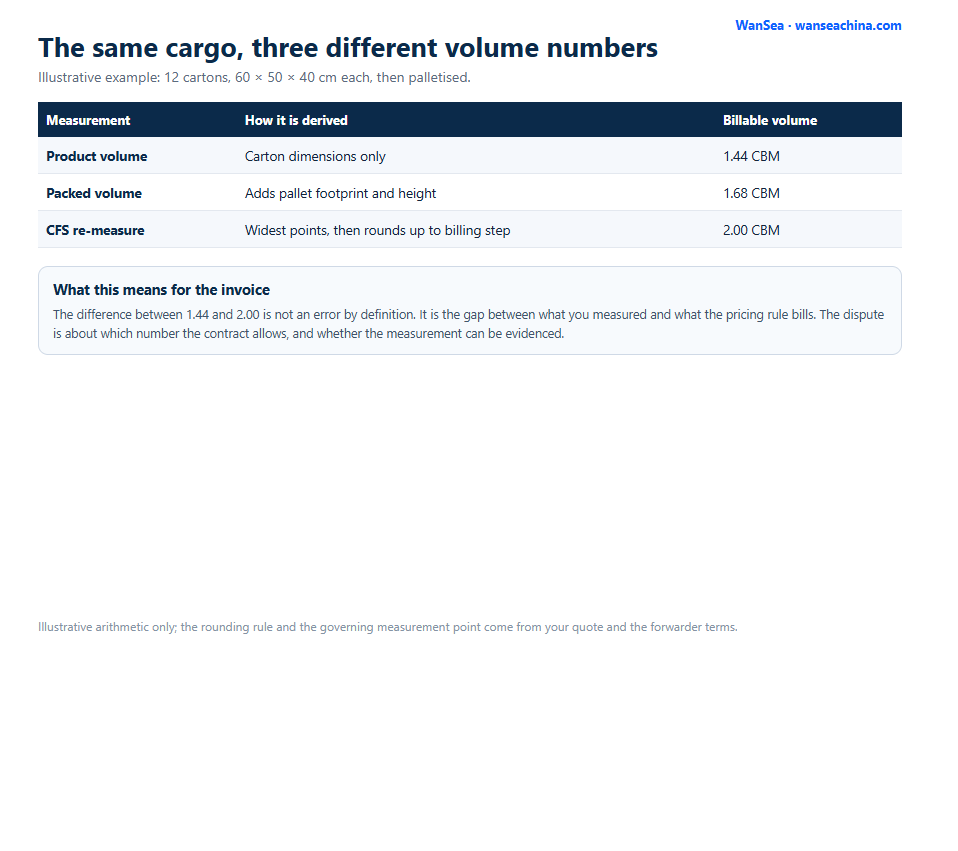
Start with the documents you already have and read them in this order: the written quotation and rate sheet, the booking confirmation, the forwarder’s standard trading terms, and the house bill of lading. You are looking for four clauses. First, who measures and where: origin warehouse, destination CFS, or either. Second, the rounding step and the minimum billable volume. Third, whether the rate is per cubic meter, per weight ton, or whichever is greater. Fourth, whether the terms allow a re-measurement and whether you are entitled to notice before the invoice is issued.
A clause saying actual measurement at the consolidation facility prevails is not unusual, and it is not unfair on its face. What it does is move the evidential burden: the forwarder must show a measurement, and you must show that the measurement or its application departs from the rule. That is a much narrower fight than arguing that your packing list should have been used. If the quote is silent on measurement, the forwarder’s standard terms usually fill the gap, and that is why the terms are worth reading before the first shipment rather than after the first dispute.
What evidence actually moves a dispute
Photographs taken at receipt are the strongest document you can hold, because they show how the cargo was presented, not how it was described. Ask the consolidation warehouse for the receiving photos and the measurement sheet: per-carton dimensions, pallet footprints, the date, and the name of the person who measured. If the shipment was weighed at the warehouse, ask for the CFS weigh ticket. If the cargo was repalletized, ask what changed and who authorized it.
On your side, keep the packing list with carton-level dimensions, the factory’s loading photos, and the trucker’s delivery receipt showing what arrived at the warehouse. A tape measure in the photo, with the date visible, converts an opinion into a record. Where the forwarder refuses to release the measurement sheet, note the refusal in writing. Refusing to evidence a charge is itself a fact worth recording, and it changes how the conversation proceeds.
Recalculate, then dispute in writing
Build one table with three columns: your figure, their figure, and the rule each side relies on. Then compute the disputed amount, not the whole invoice. A dispute that asks for a specific number with a specific basis is easy to approve or reject; a dispute that says the invoice feels high gives the other side nothing to act on.
The written dispute should contain five things: the shipment and invoice references, the measurement and pricing clause you rely on, your calculation with the carton and pallet dimensions, the evidence you are attaching, and the remedy you want, whether that is a credit note, a refund, or a corrected invoice. Send it to the party that issued the invoice, inside whatever window the terms specify, and keep the delivery record. If the terms require payment before dispute, pay the undisputed portion and state clearly in writing which portion is under dispute, so that payment is not later treated as acceptance.
When it stops being a contract argument
Most re-measurement disputes are commercial: a contract says one thing, an invoice says another, and the parties settle. A smaller number turn into a regulatory question, and that happens when the charge is inconsistent with the tariff or regulation that governs the party issuing it. Under US shipping law, assessing a party for a charge that is inconsistent with, or does not comply with, the applicable provisions and regulations is listed among the prohibited practices in 46 USC 41104.
Who the statute reaches matters before you write that letter. It applies to common carriers, including NVOCCs, so the first question is whether the invoice came from an NVOCC or from a forwarder acting as your agent. In the second case there is no carrier charge to complain about, and the route is the contract and the party’s own terms. If the invoice did come from an NVOCC, the remedy is specific: under 46 USC 41310, if the Commission determines that a charge does not comply with 41104(a) or 41102, it must promptly order a refund of charges paid, and a civil penalty under section 41107 applies.
The procedure around that remedy is the part to confirm rather than assume. The Federal Maritime Commission presents charge complaints as an expedited, fast-track route alongside formal and small-claims complaints, and directs parties to its current guidance for how a submission is made. Read that guidance on the day you file, not from a summary, because the procedural rules are the kind of thing that changes without the statute changing.
One qualification keeps the letter credible. The burden of establishing the reasonableness of demurrage and detention charges sits in a specific rule, so do not borrow that language for a cubic-meter dispute. For a volume charge, the argument is compliance with the party’s own published tariff and with the pricing clause you agreed. Say that, attach the measurement, and leave the demurrage reasoning to demurrage cases.
The worked example, line by line
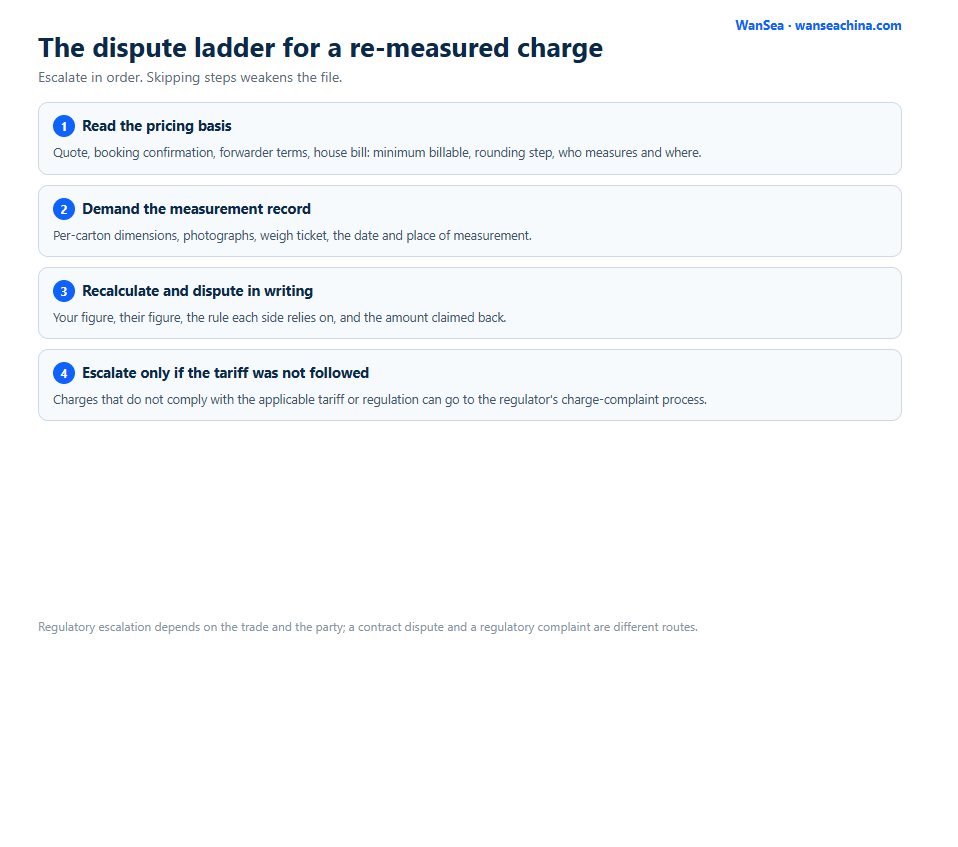
Twelve cartons at 60 by 50 by 40 centimeters measure 0.12 cubic meters each, which is 1.44 cubic meters of product. Put them on a pallet and the packed dimensions change: the pallet adds height even when the footprint does not grow, and the stack now includes the pallet itself. If the loaded pallet measures 1.2 by 1.0 by 1.4 meters, the packed volume is 1.68 cubic meters, before any shrink wrap or corner boards. Apply the 0.5 cubic meter billing step printed in the quote and 1.68 becomes 2.00.
Notice what happened: nobody lied, and the invoice is 39 percent above the packing list figure. The gap is made of pallet height and the rounding rule, and each of those is visible if you have the measurement. That is why the dispute table has three columns instead of two. Your column is the product volume, their column is the billed volume, and the middle column, the packed volume, is where most of the difference actually lives. Any dispute that only compares the first and last columns argues past the real cause.
When the forwarder is right
Some re-measurements are simply correct, and recognizing that early saves a relationship and a week of email. If the factory under-declared carton dimensions to save on its own packing cost, the warehouse measurement is the accurate one. If cartons arrived crushed or bulging, the widest point is the honest measurement. If the shipment was repalletized to fit the consolidation plan, the new footprint is what occupies the container. If the cargo is dense, the weight ratio may govern and the cube is irrelevant.
The tell is the measurement sheet. A sheet with per-pallet dimensions, a date and photographs can justify a number you did not expect. A sheet with a single total and no breakdown rarely survives a second question. Before you accuse anyone of padding, ask for the sheet and check the arithmetic yourself. If it reconciles, the correction belongs in your factory’s packing instructions, not in a dispute.
After you send it: what actually happens
A credit note is approved by whoever owns the invoice line, and that is rarely the person who answered your first email. Expect two handoffs: operations confirms the measurement, finance issues the credit. Address the first email to both, and put the invoice number in the subject line so it can be routed without a search.
If the reply is a restatement of the invoice with no measurement attached, answer once with the same calculation and a short deadline. If the deadline passes without a substantive response, the next step depends on who issued the charge. For an NVOCC, the regulatory route described above becomes available and the file you already built is the exhibit. For an agent, the route is the contract: the unpaid disputed amount, a formal notice under the terms, and whatever remedy the agreement provides.
Two mistakes cost money here. Withholding the whole invoice instead of the disputed portion turns a billing dispute into a payment default, which usually strengthens the other side. And accepting a credit note “as a gesture” without correcting the tariff basis means the same charge returns on the next shipment, because nothing in the pricing rule changed.
Weight, volume and the ratio trap
LCL rates are often quoted as weight or measure, whichever produces the higher charge, and the ratio between them is not the same on every trade. Dense goods, such as tiles, hardware and liquids in drums, can be billed on weight even when the cube is small. Light goods, such as furniture and packaging, are billed on volume. If your shipment sits near the crossover, a small change in packing can flip the billing basis, and the invoice line may look wrong when it is simply following the ratio.
That is another reason to read the quote before disputing: the ratio is usually printed there. If the quote says per cubic meter with a weight ratio of one to one thousand, and your cargo is heavier than that, the weight line is correct and the cube argument is irrelevant. If the quote is silent, ask which basis applies before the invoice arrives, not after. For the broader structure of LCL pricing, our guide to LCL cost control breaks the quote into its parts.
Prevention is cheaper than the dispute
Three clauses, agreed before booking, remove most of this risk. First, the measurement point and the measurement method: who measures, at which facility, and whether photographs and a measurement sheet are issued with the invoice. Second, the rounding step and the minimum charge, written into the quote rather than left to the standard terms. Third, a notice requirement: if the measured volume differs from the packing list by more than an agreed margin, the forwarder notifies you before the cargo is loaded, with the measurements attached.
The reason these clauses work is that they move the argument to a moment when the cargo can still be checked. After loading, the only evidence is paperwork. Before loading, the pallet is still on the floor and the tape measure still settles questions. Our LCL shipping overview explains where consolidation fits in the chain, and this China-to-USA LCL walkthrough shows how the destination side of the same invoice is built.
Confirm these five points before you pay the re-measured invoice
Before money moves, settle five points: the clause that governs measurement, the measurement sheet with dates and photographs, your recalculation of the disputed amount, the written dispute sent inside the contractual window, and whether the gap is a contract issue or a tariff-compliance issue. If the first four are in place and the fifth is clear, you are negotiating from evidence. If any of them is missing, the invoice will be paid as issued and the difference will not come back.
On our side, the consolidation warehouse issues the measurement sheet and photographs with the invoice, so the figures can be checked line by line. If you want a volume check before booking, send the carton list and pallet dimensions with the order and we will return the expected billable volume and the rounding you should expect.