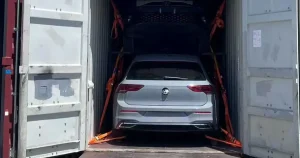

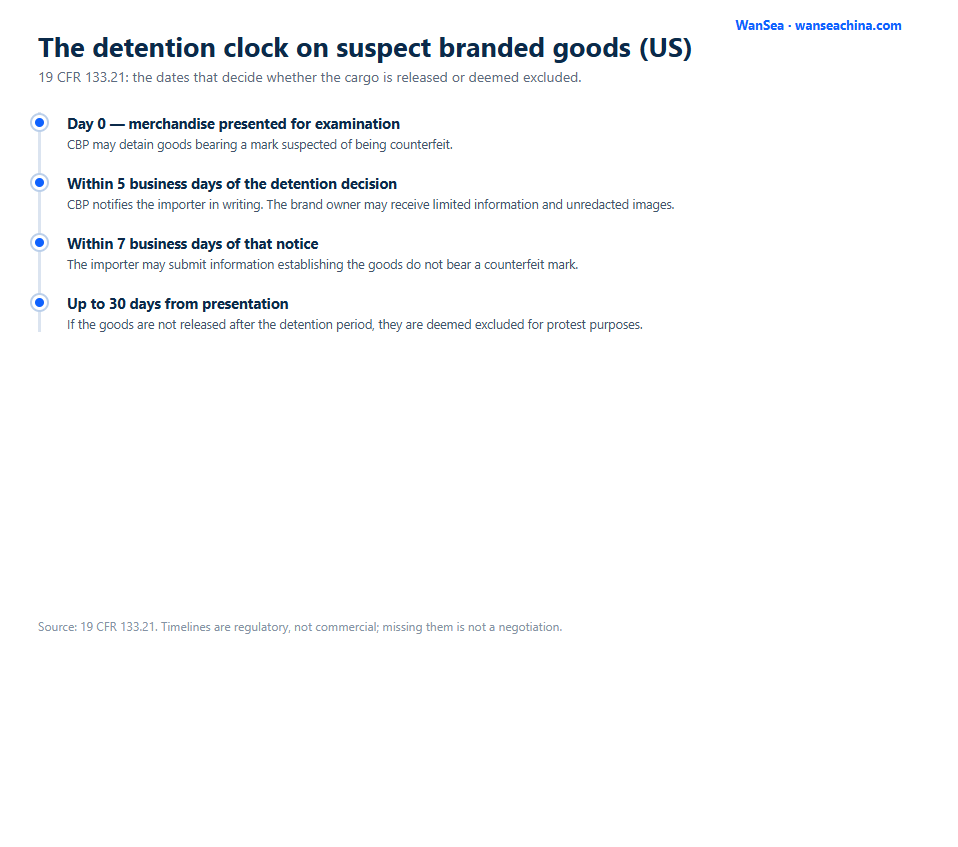
If US customs detains your shipment because it carries a recorded brand, the deadlines are regulatory, not commercial. Under 19 CFR 133.21, CBP may detain suspect merchandise for up to 30 days from the date it is presented for examination, must notify the importer in writing within five business days of the detention decision, and the importer then has seven business days from that notice to submit information showing the goods do not bear a counterfeit mark. Goods suspected of a copying mark or of being gray market follow a different track: 30 days to establish an exception under 133.22(c) or 133.23(d), and mandatory seizure under 133.22(f) or 133.23(f) if the goods are not released. For counterfeit suspects, goods not released in that window are deemed excluded so the decision can be protested. What decides the outcome is a file that connects the mark owner to this exact shipment.
The three categories customs actually uses
Importers talk about “branded goods” as one problem. Customs treats it as three, and the paperwork differs for each. Counterfeit marks are spurious marks identical to, or substantially indistinguishable from, a registered mark. Copying or simulating marks imitate a registered mark closely enough to cause confusion without being identical. Gray market goods are genuine articles bearing a mark identical or substantially indistinguishable from one owned and recorded by a US person or company, imported without that owner’s authorization. A mark owned abroad and not recorded in the US is generally outside this restriction.
The distinction matters before the container ships, because the evidence you need is different. A counterfeit allegation is answered with proof that the mark owner authorized this production and this importation. A gray market question is answered with proof that the import is permitted despite the channel, which usually means the mark owner’s written consent or an applicable exception. A copying allegation sits between the two and turns on how close the imitation is, which is a judgment you cannot win with a purchase invoice alone.
The clock, and why it is shorter than it looks
Three dates matter and they run in sequence, not in parallel. The detention itself can last up to 30 days from presentation for examination, which is the outer limit rather than the working time. The notice must reach the importer within five business days of the decision to detain, and the response clock starts from that notice, not from the day your forwarder tells you something is wrong.
In practice, the seven business days are consumed by collecting documents from three different parties: the brand owner or its licensee, your supplier, and your own purchasing records. If any of those parties is slow, the window closes. That is why the file should exist before the goods arrive, and why a shipment with a visible third-party brand deserves a pre-flight check even when the supplier swears the goods are genuine.
For the other two categories the timeline is different and shorter to explain. Where goods are suspected of bearing a copying mark, or are restricted gray market articles, 19 CFR 133.25 detains them for 30 days from presentation for examination, requires notice of the detention decision within five days, and lets the importer use that period to establish one of the exceptions in 133.22(c) or 133.23(d). The period can be extended for good cause. What it does not offer is the counterfeit track’s deemed excluded outcome: under 133.22(f) and 133.23(f), goods not released inside the detention period are seized and forfeiture proceedings begin. That is a worse ending than a protestable exclusion, and it is why the category matters before the response letter is written.
What the notice tells you, and what the brand owner sees
The notice is not a courtesy call. It tells you that CBP suspects the mark, and it sets out what you can submit. Separately, the regulation requires CBP to give notice of the detention decision, and it allows limited information about the shipment to reach the owner of the recorded mark. For counterfeit suspects it also allows unredacted photographs to be disclosed unless the importer establishes, within seven business days, that the goods do not bear a counterfeit mark. In other words, the brand owner may see your cargo before you have finished assembling your defense.
The seven-day response pack
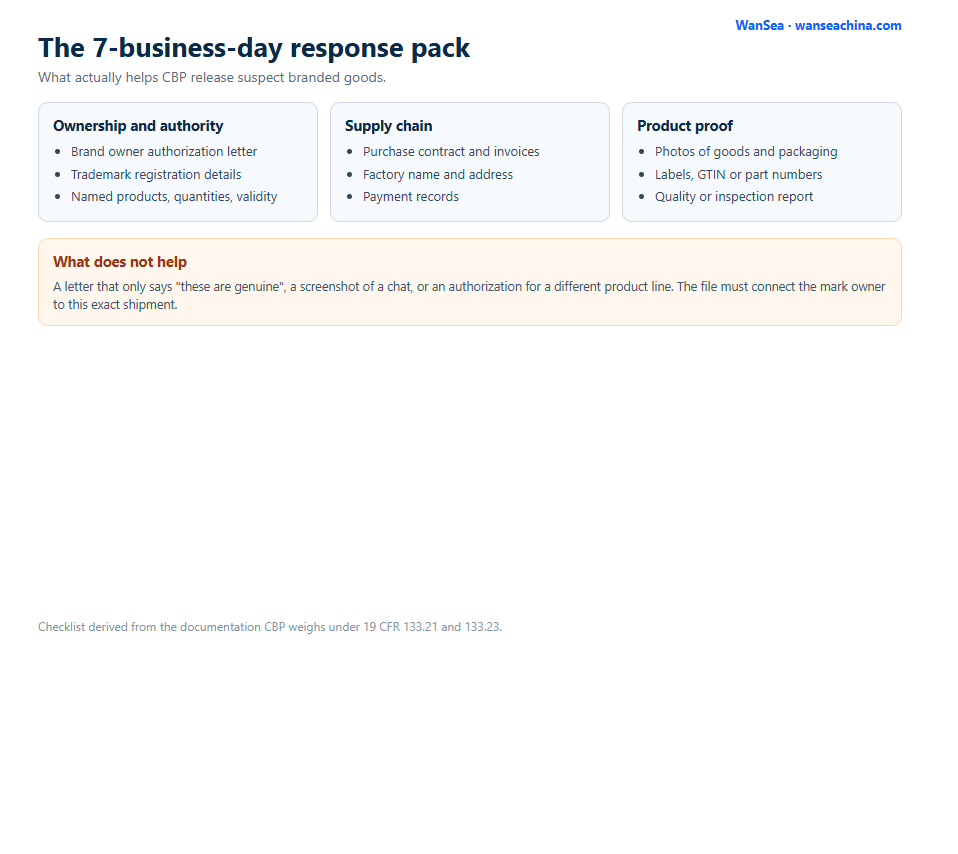
Four document groups do most of the work. First, authority: a letter from the mark owner or its authorized licensee that names your company, the product, the quantity and the period covered, on letterhead, with contact details that customs can verify. An authorization for a different product line, or one that expires before the shipment date, does not answer the question. Second, supply chain: purchase contract, commercial invoices, factory name and address, and payment records that match the shipment. Third, product proof: photographs of the goods and packaging, labels, GTIN or part numbers, and any inspection or quality report. Fourth, a short covering statement that maps each document to the element customs is testing.
What does not help is a letter that asserts authenticity without evidence, a screenshot of a chat with the supplier, or a trademark registration certificate in your own name for a different class of goods. The question is not whether the brand exists; it is whether this production and this import were authorized.
Genuine goods are not automatically free to import
Restricted gray market goods are genuine, which is why importers underestimate them. The test is ownership and authorization, not authenticity: the mark must be owned and recorded by a US person or company, and the import must lack that owner’s authorization. The release routes are specific. Under 133.22(c), goods may enter if the mark is removed or obliterated as a condition of entry, if they are imported by the recordant or its designate, if the recordant gives written consent, or under the narrow personal exemption. Under 133.23(d), genuine gray market goods may enter where the mark was applied under common ownership or control and the goods are not physically and materially different, or where a conspicuous label in close proximity to the mark states that the product is not authorized by the US owner and is physically and materially different.
The practical test is simple. Ask the supplier for the channel: who manufactured the goods, under what agreement, and for which market. If the answer is “the same factory, but a cancelled order”, that is a gray market conversation waiting to happen. If the answer is “our own brand, registered by us”, check who actually owns the registration in the destination market before the goods ship.
Che cosa “recorded” means, and how to check it
Recordation is what puts a mark into the detention process described here: CBP learns of the mark through its electronic recordation programme. Counterfeit enforcement does not depend on recordation, but the 133.22 and 133.23 process does. Recording is a step the mark owner takes, which is why two similar brands can have very different border experiences, and why the process here is built around recorded marks.
For an importer, the practical question is whether the brand on the goods is recorded for the product class you are importing. That check belongs in the sourcing phase, alongside the price negotiation, because it decides whether an authorization letter is a nice-to-have or the document that releases the container. If the supplier cannot tell you who owns the mark in the destination market, treat that as missing information rather than as a detail to resolve later.
Three supplier stories that fail at the border
The first is OEM surplus: goods made for a brand under contract, where the order was cancelled or overrun and the factory sells the remainder. The goods may be genuine, but they were not authorized for your import, and that is the gray market question the regulation addresses. Without the mark owner’s written consent, the story does not answer the detention notice.
The second is “same factory, same line”. Importers often hear this as reassurance. Customs hears it as a statement that the goods were produced on equipment capable of making the branded product, which is not the same as authorization. The factory’s identity is useful evidence, but it is not consent.
The third is the rebranded look-alike: a logo altered just enough to avoid being identical. That is the copying or simulating mark category, and it is the hardest to defend because the question is one of impression rather than paperwork. A purchase invoice from a factory that copied a design does not convert the import into a lawful one. The one route 133.22(c)(1) does offer is removal or obliteration of the mark as a condition of entry, and 133.22(d) withholds even that option from counterfeit goods.
Who customs treats as responsible
The importer of record is the party customs notifies and the party whose file is tested. A forwarder or broker that files under its own bond is the importer of record and is the party CBP notifies; where it files as your agent, the file and the brand-owner relationship stay with you, which is why the response cannot be fully delegated. That is why the authorization letter has to name your entity and cover the goods, not the forwarder’s.
The usual failure is a good argument delivered by the wrong party. For the wider chain around the entry, see this guide to shipping from China to the USA.
Checking the brand before you buy
Three checks cost nothing and prevent most of these shipments. First, search CBP’s IPR e-Recordation records for the brand and the product class; if the mark is recorded, treat the shipment as a detention risk until you hold an authorization letter. Second, read the authorization letter for scope: products, quantities, territories, validity dates, and whether it covers imports by your entity. Third, check the supplier’s own trademarks. A supplier selling you “their brand” that is actually a registered mark owned by someone else is a red flag that no invoice can cure.
Keep the authorization letter and the purchase chain in one folder per shipment, so the response becomes an assembly job rather than an investigation, and brief the party filing the entry that a brand question is possible. The boundary between what a forwarder handles and what the importer must own is covered in this explainer on forwarders and customs, and the destination side of the same chain is set out in our customs clearance overview.
If the response fails
The ending depends on which track the goods are on. For counterfeit suspects, continued detention past the period is deemed an exclusion for the purposes of 19 USC 1514(a)(4), which makes that decision protestable. That is not the end of the story: under 133.21(e), once CBP determines the goods bear a counterfeit mark it will seize them and, absent the recorded owner’s written consent, forfeit them. The protest route runs alongside the seizure track rather than replacing it. For copying marks and gray market goods, 133.22(f) and 133.23(f) provide that the merchandise shall be seized and forfeiture proceedings instituted, with notice and a right to petition for relief under part 171 of the customs regulations. Where goods have already been released, 133.26 lets customs demand redelivery.
Civil fines are a separate layer, and they attach to counterfeit importations under 133.27. None of this is inevitable, and the shipments that end badly usually do so because the authority documents could not be produced inside the window. The regulation is unforgiving about time and comparatively forgiving about substance: a clear, sourced file submitted early beats a perfect argument submitted late.
When the brand owner will not answer
The most common small-importer outcome is not a legal argument; it is silence. A brand owner that does not recognise your supplier, or does not want the channel, simply does not reply. The options are unglamorous and time-limited: abandon the goods, export them, or destroy them under customs supervision, while storage or demurrage keeps accruing.
Two decisions make it survivable: agree in writing who bears storage if the goods are held, and decide before shipping whether the order is worth the exposure, because a stopped first shipment costs a deposit rather than a container.
Collect these five documents before the container reaches the US
Before the vessel arrives, assemble five items and keep them together: the mark owner’s authorization letter with product and validity scope, the purchase contract and invoices, the factory’s identity and address, product and packaging photographs with labels and part numbers, and a one-page statement mapping each document to the goods. Then confirm who files the entry and that they know a brand question is possible. If any item is missing, the cheapest time to fix it is now, while the container is still at sea and the brand owner still answers email. If you want the authorization scope and recordation status checked before booking, send the brand, the product and the destination and we will review it against the register.