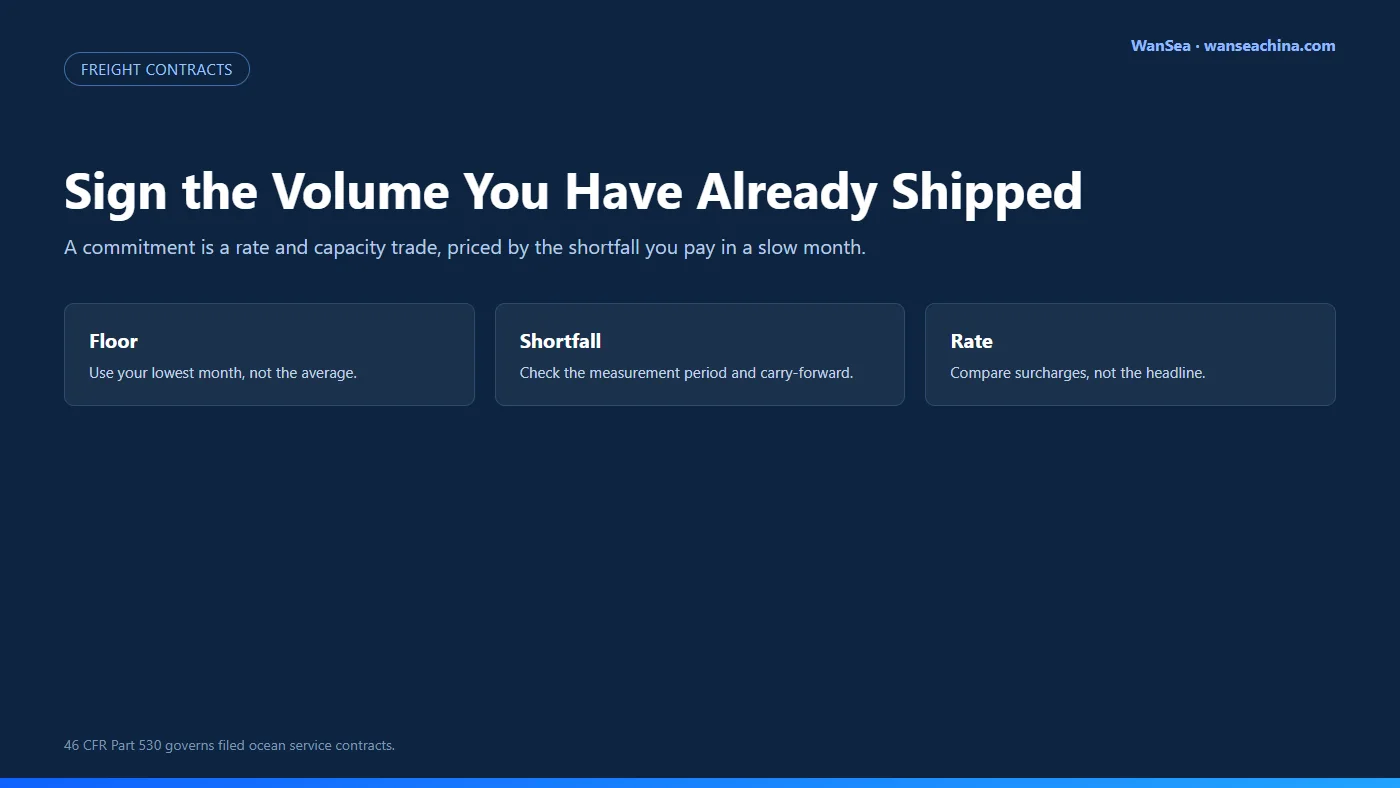
A volume commitment is worth signing when the quantity in the contract is a number you have already shipped, not a number you hope to ship. The contract trades a rate and a capacity promise for a commitment, and the commitment is enforced by a shortfall charge if you fall below it. So the test is arithmetic on your own history: take the last twelve months, remove the one-off peak, and see whether the lowest realistic month still clears the floor. If it does not, stay on spot rates or ask for a rate agreement without a volume clause.
What you are actually committing to
The commitment, often written as a minimum quantity commitment (MQC), can be measured in containers, in TEU, in chargeable weight, in spend or in a share of your total volume. Whatever the unit, the contract converts it into a floor: a minimum you must tender or pay for. In return you get a rate that is fixed, capped or linked to an index, and a capacity allocation for the lanes named in the contract.
Two things are easy to miss when the document is presented as a rate agreement. The first is that the commitment is usually measured over a period, not per shipment, so a strong quarter can cover a weak one only if the contract allows that averaging. The second is that the allocation is for named lanes and equipment types, so a commitment on China to Los Angeles does not protect a booking to Rotterdam.
The only number that matters: your worst month
Most importers size a commitment from an average, which is the number that flatters the deal. The contract is not tested by the average; it is tested by the month when orders slow, a customer cancels, or the Chinese New Year shutdown removes two weeks of production. Use the lowest month in the last twelve as the starting point, then ask whether the year ahead contains anything that makes that month worse.
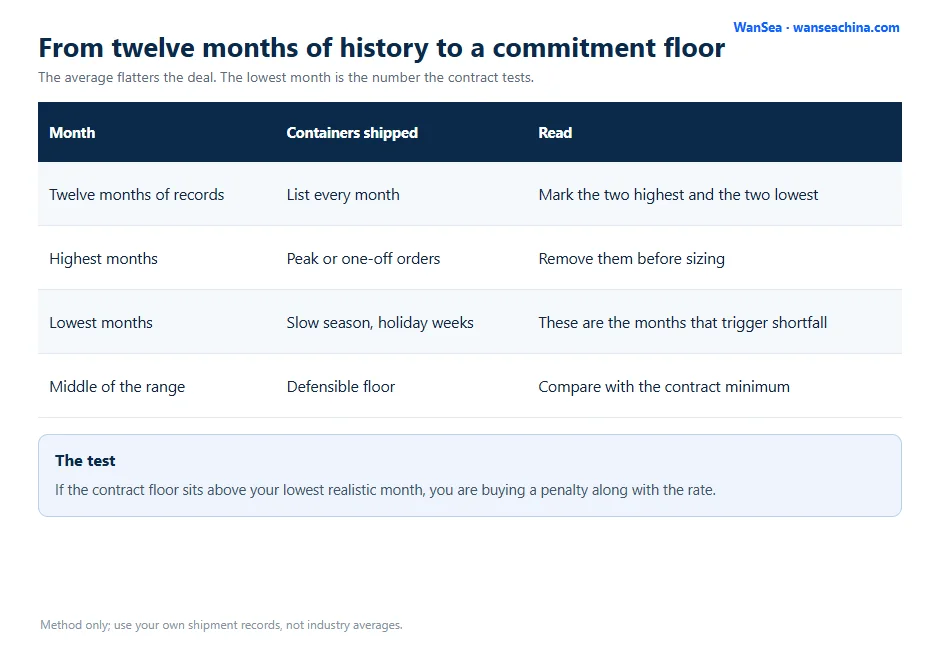
A workable method is to list your monthly volume for the last year, mark the two highest and the two lowest, and read the middle. The middle is what you can defend in a bad quarter. If the contract floor sits above it, you are buying a rate with a penalty attached, and the penalty is the part the sales conversation tends to skip.
Where the shortfall charge hides
The shortfall clause is rarely called a penalty. It appears as an MQC with a rate adjustment, a dead freight charge, or a clause that removes the contract rate for the following period if the volume is missed. Each version has the same effect: you pay for capacity you did not use.
Read three details before signing. First, the measurement period and whether unused volume can be carried forward. Second, whether the shortfall is charged at the contract rate, at a penalty rate, or as the difference between contract and spot. Third, whether force majeure, port disruption or a carrier’s own rollover excuses the shortfall or counts against you anyway. A contract that counts a carrier’s canceled sailing against your commitment is not a capacity promise; it is a volume test with the risk on your side.
There is also a credit mechanism worth asking about. Some contracts let unused volume move to the following period, or let an over-shipment in a strong month offset a weak one. A contract with that allowance behaves very differently from a contract that measures each period in isolation, and the difference only appears in the year you need it.
How a commitment is priced against spot
Three rate structures appear in these contracts. A fixed rate holds for the period and is the easiest to compare. A capped rate floats with an index but cannot exceed a ceiling. A formula rate follows an index directly, with a margin added. Each one protects against a different risk, and only the fixed structure protects against the market moving up sharply.
To compare an offer with spot, build a table with one column per month and one row per cost line, then fill the contract column from the rate sheet and the spot column from the invoices you actually paid. The comparison only works on the same lane, the same equipment and the same surcharge basis. A contract rate that looks lower than spot often is lower on the base and equal on the surcharges, which is a smaller saving than the headline.
What a share-based commitment looks like
A share-based commitment replaces the absolute floor with a percentage: you agree to route a defined share of your volume on the named lanes through the provider, and the rate holds as long as the share is met. The advantage is that the commitment scales with your business; if your volume falls, the absolute quantity falls with it.
The disadvantage is verification. Ask how the share is measured, what counts toward it, and what happens in a month when a customer diverts a shipment to another route. A share clause without a written measurement method is an argument waiting for a slow quarter.
Rate linkage and the surcharges outside the rate
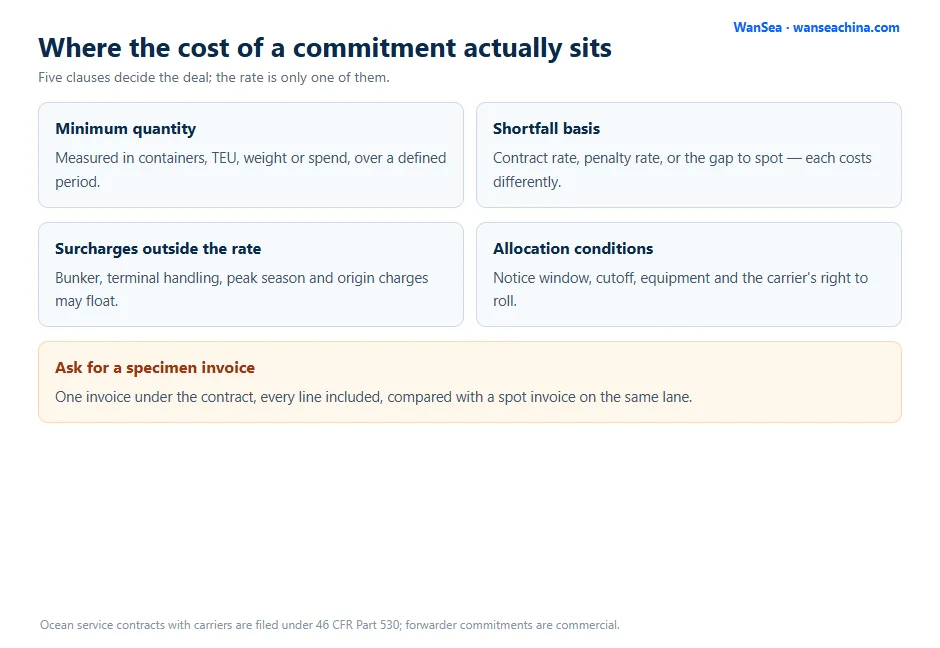
A contract rate is rarely an all-in number. Bunker adjustment, terminal handling, peak season surcharge and origin charges may sit outside the rate, and an indexed rate can move with the market even when the contract is “fixed”. Ask for a specimen invoice under the contract, with every line that can appear, and compare it with a spot invoice for the same lane. If the surcharge stack is identical, the contract is buying rate stability, not a lower price.
That distinction decides whether the deal is worth the commitment. A contract that fixes the base rate but leaves the surcharges floating gives you less protection than the sales deck suggests, and it is the surcharge stack that moves most in a tight market.
Capacity promises are conditional
Allocation language usually carries conditions: booking within a notice window, cargo ready by a cutoff, equipment availability, and the carrier’s right to roll cargo when the vessel is full. Those conditions are normal, but they change what the promise means. An allocation that depends on booking two weeks ahead is not the same as guaranteed space, and a shipper who books late will discover the difference in the peak season.
Ask what happens in the week before a holiday, when everyone wants the same sailing. If the answer is that allocation is subject to space and equipment, the contract is a rate agreement with a preference, not a capacity guarantee, and the price should reflect that.
When a forwarder contract differs from a carrier contract
Ocean service contracts between shippers and ocean common carriers sit inside a regulatory regime: they must be filed with the Federal Maritime Commission under 46 CFR Part 530, which sets out what a service contract must contain. A commitment you sign with a forwarder is a commercial agreement rather than a filed ocean service contract under Part 530, and what it commits you to is whatever the clause says. That is not a reason to avoid it, but it is a reason to read the exit terms more carefully than the rate.
For most small and mid-sized importers, the forwarder route is the realistic one, because direct carrier contracts typically come with volume thresholds. Our ocean freight service is built around consolidated buying for exactly that reason, and the alliance structure behind the schedules explains why capacity moves between carriers even inside a contract period.
The questions to put to the sales team
Seven answers decide whether the contract is sound: the measurement period and whether volume can be carried across months; the shortfall basis and who pays it; the full surcharge list with a specimen invoice; the allocation conditions and the notice window for booking; what happens if the carrier cancels or rolls a sailing; the notice period to terminate; and whether the rate survives a change in your product or packaging. Ask for each in writing, and treat a verbal answer as a placeholder.
A provider that answers all seven quickly is usually the one that has done this before. A provider that answers three and refers the rest to a template is telling you where its operations stop, and that is useful information before the first booking rather than after the third. A forwarder that handles your bookings and can produce the specimen invoice and the allocation terms in one document is the simplest test of that.
Watch the calendar before you commit
Most volume commitments run twelve months, but the shipping year is not flat. The weeks before Chinese New Year compress production and departures, the period after the holiday runs light, and the peak season pushes rates and space in the second half. A commitment sized on a twelve-month average can be comfortable in March and impossible in February.
Mark those weeks on the same table you used to size the floor. If two or three months sit below the contract minimum, the shortfall clause will be tested every year, and the rate you negotiated has to be strong enough to pay for it. In most cases it is not, which is why the lowest month, not the average, is the number to negotiate around.
When not to sign
There are clear cases where the answer is no. If your volume depends on one customer, the commitment is a bet on that customer staying. If your product mix changes seasonally, a flat annual floor does not fit. If you are testing a new lane, a commitment on that lane is a commitment to a route you have not run. And if the only benefit offered is a rate that is close to spot, the contract is buying a penalty without buying a price.
The alternative is not nothing. A forwarder can offer a rate agreement without a volume floor, or a commitment to a share of your volume rather than an absolute number. Both keep the relationship and remove the shortfall risk, and both are worth asking for before accepting the standard template.
Sign the Volume You Have Already Shipped
A volume commitment is a rate and capacity trade, and its cost is the shortfall you pay in the month you cannot fill it. The safe floor is your own low month, not your average, and the contract is only as good as its surcharge stack and its capacity conditions. Everything else in the negotiation is secondary to that floor, the shortfall basis and the capacity conditions.
Before you sign, pull twelve months of shipment records, mark the lowest month, and compare it with the contract floor. If the floor is above it, ask for a share-based commitment or stay on spot; if the floor is below it, the contract can work, and the next step is to get the specimen invoice and the allocation conditions in writing.