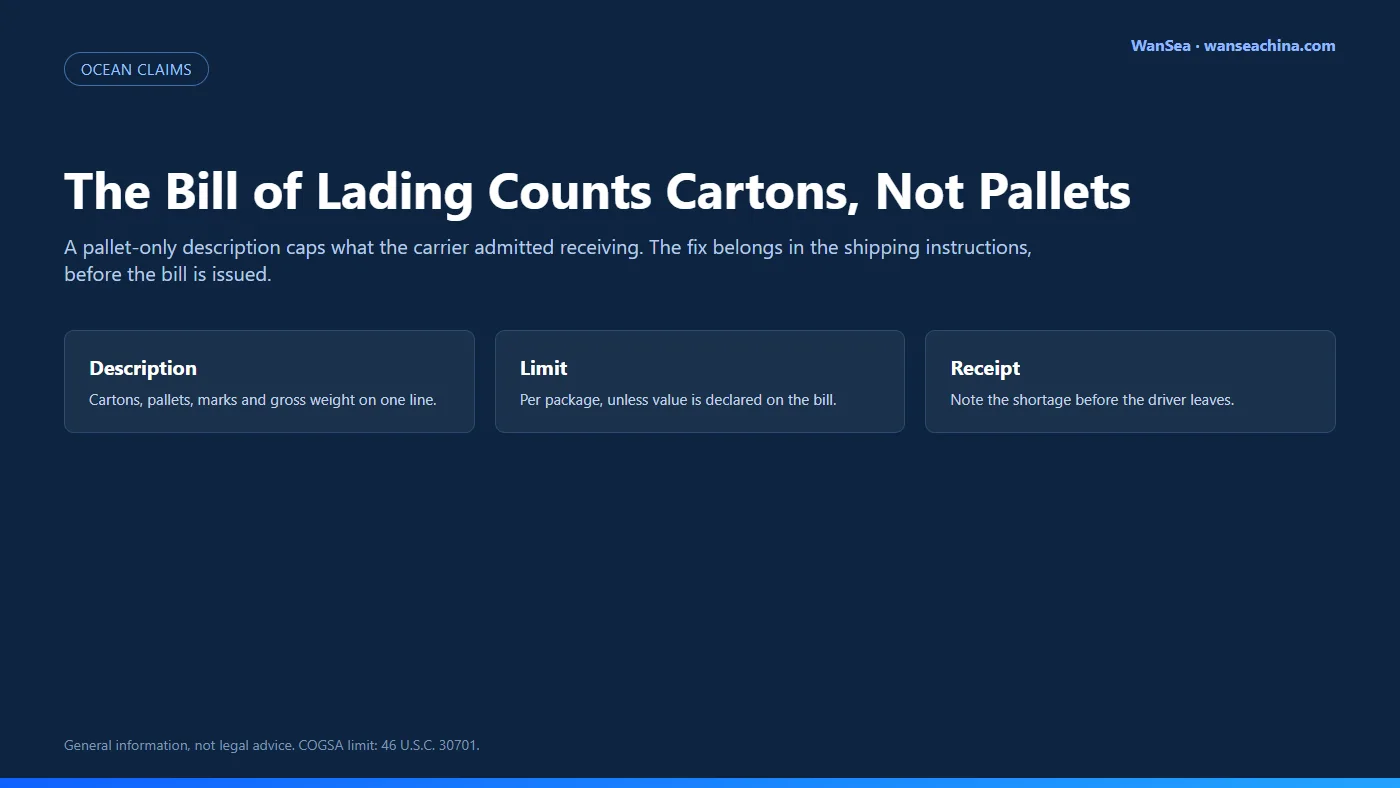
If your bill of lading says six pallets and the carrier delivers six pallets, a missing carton is a fight you start with weaker evidence. The B/L is the carrier’s receipt for what it accepted, so the description written at origin sets the size of the claim before any damage happens. Fix it in three places: ask the supplier to state the carton count and the pallet count in the B/L description, keep the invoice and packing list consistent with it, and read the description back before the vessel sails. If the cargo value per package is above the legal limit, declare the value on the B/L and pay the extra freight instead of discovering the ceiling during a claim.
What the bill of lading actually proves
A bill of lading does three jobs at once. It is a receipt for the goods, evidence of the contract of carriage, and, when issued “to order”, a document of title. The receipt function is the one that matters in a shortage claim, because the carrier’s liability starts from what it acknowledged receiving. Federal law makes the bill prima facie evidence of the goods as described in it, and treats the marks, number, quantity and weight as the shipper’s own statement, which is why the description is not a formality the shipper can leave to the forwarder.
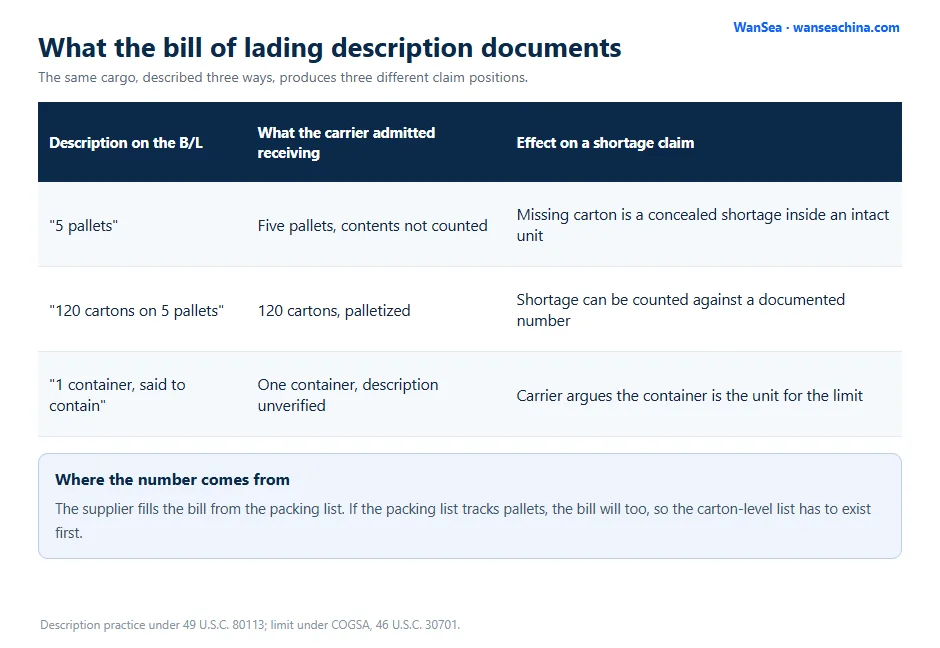
That is also why the phrase “said to contain” appears on so many bills. It is the carrier telling the reader that the description came from the shipper and was not verified by counting. It protects the carrier against a claim that it received goods it never saw. It does not protect the shipper, because the shipper is the party who supplied the number.
The package limit and how the count changes it
Ocean carriage under the Carriage of Goods by Sea Act (COGSA) limits the carrier’s liability to a fixed amount per package, or per customary freight unit for goods not shipped in packages, unless the shipper declares the nature and value of the goods before shipment and inserts that declaration in the bill of lading. 46 U.S.C. § 30701 carries the text of that provision, including the $500 figure that has applied per package since the 1936 Act. A pallet of cartons worth several thousand dollars therefore sits behind a ceiling that has nothing to do with its real value.
The count is what turns the limit into money. If the bill enumerates the packages, the shipper has a basis for arguing that the limit applies to those units rather than to the whole container. If the bill describes only the container, or only the pallets, the carrier will argue that the described unit is the package and that the ceiling applies once. That argument is the practical reason to care about the description: the same cargo, described two ways, produces two very different claim values.
Why a bare pallet count is the wrong default
Suppliers default to pallet counts because that is what the warehouse handles. A pallet is easier to load, easier to count at the gate and easier to write on a form. The problem is that the pallet is not the unit your customer ordered. Your invoice is per carton, your Amazon shipment is per carton, and your claim is per carton. When the B/L stops at the pallet, the document and the commercial reality no longer match, and the gap is where claims die.
There is a second effect that rarely gets discussed at booking. A pallet count makes an internal shortage invisible until the pallet is broken down at destination. If the pallet arrives intact and the delivery receipt is signed for six pallets, the missing carton is discovered later, in your warehouse, away from the carrier’s representative. Late discovery weakens the chain of custody, and the carrier’s response writes itself: the cargo was delivered as described.
What the description should say
A workable description names the goods, the number of cartons, the number of pallets, the marks and the gross weight, and it matches the packing list line for line. Something like “120 cartons of ceramic mugs, packed on 5 pallets, marks ABC-118, gross 2,340 kg” tells the carrier exactly what it accepted and gives a surveyor something to count against. A description that says “ceramic ware, 5 pallets” leaves the carton count undocumented.
Ask for the change in writing, before the shipping instructions are submitted. The supplier’s export team fills the B/L from the packing list, so the packing list has to carry the carton count first. If the supplier’s system only tracks pallets, ask for a carton-level packing list as a separate document and attach it to the shipping instructions. Most suppliers can produce one, because the carton count is on the production records.
Consolidated cargo needs the same treatment, with one twist. In LCL the document you hold is usually the forwarder’s house bill, not the carrier’s bill, and the description on the house bill is what your claim runs against. Ask the co-loader, through the forwarder, for the same carton-level description, and ask the forwarder to confirm the house bill and the master bill agree before the container is loaded.
When declaring a value is worth the extra freight
Declaration is not free. It changes the carrier’s exposure, so the carrier prices it, and the ad valorem charge can be a meaningful addition on high-value cargo. The test is simple arithmetic: compare the declared-value charge with the gap between the package limit and the real value of the cargo at risk. At the statutory minimum, a shipment described as five packages caps the carrier’s exposure at $2,500, which is a low ceiling for five pallets of instruments. For low-value, high-volume goods the limit rarely binds; for electronics, instruments or branded goods, the gap is usually large enough that the declaration charge is cheaper than the exposure.
Do the arithmetic per package, not per shipment. A container holding cheap cartons and one expensive item has a mixed exposure, and the expensive item is the one that justifies the declaration. If the shipper declines to declare, ask for the refusal in writing, because the decision belongs to the party that owns the risk.
Mixed SKUs on one pallet
A mixed pallet is the harder case, and it is common for e-commerce orders where several items ship together. The usual description collapses the pallet into a single line, which is exactly where a claim for one SKU becomes unprovable: the pallet was delivered, so what is missing. Ask for the B/L to carry the total carton count and the packing list to break the pallet down by SKU, carton count and marks. The bill does not need a line per SKU, but it does need a carton number that the packing list can explain.
If the supplier ships the same pallet configuration every month, build the description once and reuse it. The repetition is what makes the count defensible, because the carrier’s gate team sees the same pattern and stops treating the carton number as a guess.
If the supplier will not enumerate
Some suppliers refuse carton-level descriptions because their export clerk fills the bill from a pallet-level system. That is a systems answer, not a legal one, and it does not change who carries the exposure. Two fallbacks work. The first is an origin survey: an independent inspector counts the cartons and photographs the pallets before loading, and the report goes into the claim file even though the bill stays at pallet level. The second is the value declaration, which caps the argument at the declared number instead of the statutory minimum.
Neither fallback is as cheap as the description, and both depend on being arranged before the container is sealed. A survey after loading proves very little, because the pallets are no longer visible.
The delivery receipt is the other half of the file
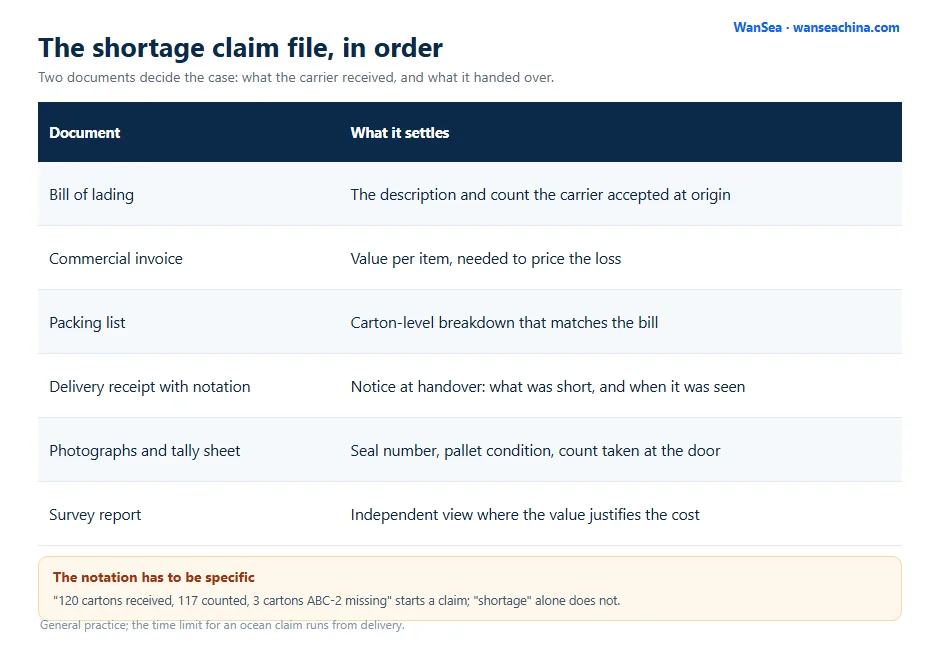
A shortage claim is decided by two documents, not one. The B/L shows what the carrier received; the delivery receipt shows what it handed over. If the receipt is signed clean, the carrier’s position is that the cargo arrived complete, and the missing carton becomes a warehouse problem. If the receipt carries a notation, the carrier has notice and the claim has a start date.
Notation has to be specific to work. “Shortage” alone is weaker than “120 cartons received, 117 counted, 3 cartons of item ABC-2 missing, pallet 4 opened”. Count the cartons before signing, photograph the pallet and the seal, and keep the tally sheet with the receipt. If the driver will not wait for a count, sign with the notation “count not verified, cartons pending” and confirm by email the same day, because a clean signature followed by a next-day email is easy for a claims department to dispute.
What a shortage claim needs, in order
The file has a fixed shape: the bill of lading, the commercial invoice, the packing list, the delivery receipt with its notation, photographs of the seal and the pallet, a survey report if the value justifies one, and a written demand that states the amount and the basis. Send it to the carrier or to the forwarder that booked the shipment, and keep the dates because an ocean claim has deadlines: written notice before or at removal, or within three days where the loss is not apparent, and suit within one year of delivery.
Insurance and carrier liability are separate paths, and this is where most importers lose time. The carrier’s limit may be far below the cargo value, and the cargo policy may respond only after the carrier’s liability is established or may exclude the shortage entirely. Our guide to carrier liability and cargo insurance sets out how the two interact, and the ocean freight service page shows where the bill of lading description is fixed in a booking.
Where the fix belongs in the booking sequence
The description is written once, early, and it is expensive to change later. It belongs in the shipping instructions, which the shipper sends before the bill is drafted. If you want the carton count on the bill, the request has to be in that message, together with the packing list that supports it. After the bill is issued, a correction becomes an amendment, which carries a carrier charge and a delay, and the amendment may arrive after the vessel has sailed.
Two habits prevent most of this. First, read the draft bill before it is issued, not after. Second, compare the description with the invoice and the packing list, because a mismatch between three documents is the detail an inspector or a claims handler notices first. Our guide to cargo release documents shows the same consistency test from the release side, which is where a mismatch becomes a fee instead of a claim.
The Claim Is Decided at Booking, Not at Delivery
A shortage claim is not won by arguing harder after the container arrives; it is won by the description the carrier accepted at origin. If the bill names the cartons, the claim has a per-package baseline the shipper can argue from, the receipt has a count to check, and the loss has a number. If it names pallets, every later step is an argument about what was inside something the carrier never counted.
Before the next booking, ask three questions in writing: does the draft bill show the carton count, does the packing list show the same count, and is the cargo value per package above the limit. If any answer is no, fix it in the shipping instructions, because that is the last moment the document is still free to change.