Forty cartons is not a volume decision. It is a fixed-cost decision. At that size, the difference between sea, air and express is rarely the per-cubic-meter rate or the per-kilo rate; it is the minimum charge, the origin handling fee, the destination fee and the time cost that sit on top. LCL quotes a shipment minimum even when your cargo occupies less than a cubic meter of space, air bills the greater of actual and volumetric weight, and express bundles handling into a per-parcel price. The only reliable way to choose is to put three all-in quotes on one page and compare the fixed lines first.
Why the per-cubic-meter rate misleads
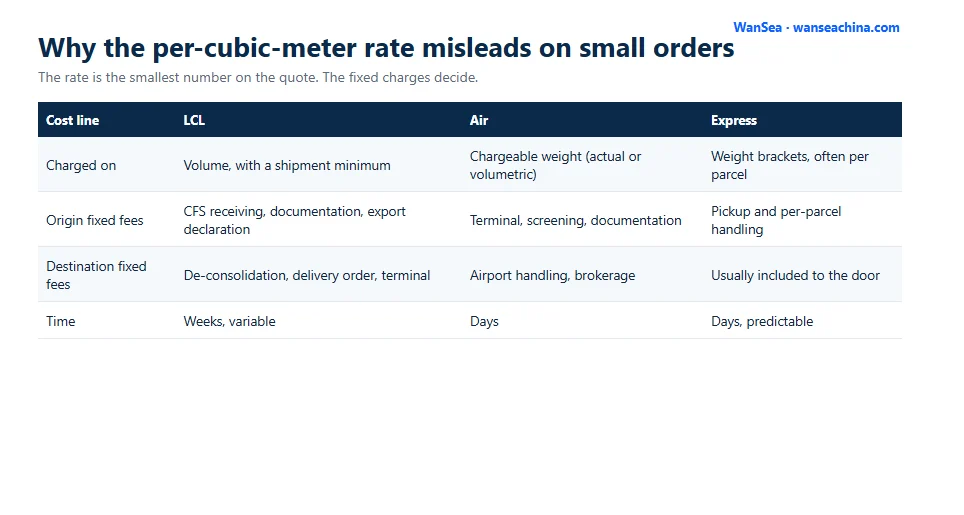
LCL pricing looks simple on a rate sheet: a number per cubic meter, plus a minimum per shipment. On a small order the minimum, not the rate, is what you pay. Forty cartons that measure 1.6 cubic meters can be billed as two cubic meters after the rounding step, or as the shipment minimum if that is higher, and the difference between a cheap rate and an expensive one can disappear inside the minimum.
The same logic applies at the destination. De-consolidation, delivery order and terminal fees usually carry a per-shipment minimum, and some are billed per cubic meter or per revenue ton, so they weigh more heavily on a small consignment. A quote that shows only the ocean rate is not a quote; it is the first line of one. Ask for the fixed fees on both sides before you compare anything else.
The fixed costs that do not shrink
Origin handling is the first block. For LCL it includes receiving at the consolidation warehouse, measuring, documentation and the export declaration; for air it includes terminal handling, screening and documentation; for express it is usually bundled into the per-parcel price. None of these lines fall when the cargo is small, and several of them have a minimum of their own.
Destination handling is the second block. LCL carries de-consolidation and a delivery order; air carries airport handling and brokerage; express usually delivers to the door with its handling fees included, though duties and taxes are a separate question. The third block is the one importers forget: the cost of the time the cargo spends in transit. A slower mode is not free if it forces you to hold safety stock, miss a launch date or pay for storage at the other end.
Air freight’s chargeable weight trap
Air freight is billed on the greater of actual weight and volumetric weight, and the volumetric divisor turns bulky cartons into billable kilos. Cartons that are light but large, which is common for packaging, furniture fittings and soft goods, can be billed at several times their scale weight. That is not an error; it is how the aircraft’s space is priced.
The practical consequence for a small order is that air can be cheaper than expected for dense goods and much more expensive for bulky ones. Check the packed carton dimensions before requesting an air quote, and ask the provider to show the volumetric calculation. If the cargo is bulky, reducing carton size or removing void fill can change the billable weight more than negotiating the rate. The IATA cargo framework is the reference point for how air charges are structured.
When express genuinely wins
Express wins on small, dense, urgent shipments where the door-to-door service removes handling you would otherwise pay for. The threshold is not a fixed number of cartons; it is the point where the express all-in price lands close to the air all-in price after you add pickup, terminal handling and destination brokerage. Below that point, express is often the cheapest complete service, not the most expensive.
Express also wins when the destination is not well served by air cargo. A city that requires an inland leg from the airport can erase the difference between air and express, because express has already priced the final delivery. For a first order or a sample run, that simplicity has real value: one provider, one tracking number, one invoice.
Three questions that change the answer
The first question is density. Divide the shipment weight by its volume, and compare the result with the ratio the air or LCL tariff uses. Dense cargo, such as tools or hardware, usually bills close to its actual weight and behaves differently from light cargo, such as packaging or soft furnishings, which bills on volume. The same forty cartons can be a good air shipment or a poor one depending on that ratio.
The second question is the deadline. If the goods must be on a shelf by a date, the mode is chosen by the date, not by the rate. If the goods are replenishment for stock you already hold, the slower mode is usually correct, because the shelf is already supplied and the inventory carrying cost is lower than the air premium. The third is the destination: a city with a busy air cargo airport and a short inland leg is cheaper to serve by air than a city that requires a long truck leg after arrival, and the difference can be larger than the freight itself.
The consolidation wait nobody quotes
LCL does not sail when your cargo is ready. It sails when the consolidator has filled the container or reached the scheduled cut-off, which is why the sea transit quote is a range rather than a date. For a single small order, that wait can add days or weeks, and it is not visible in the per-cubic-meter rate.
Ask the forwarder how often the lane consolidates and what the cut-off is. A lane that consolidates twice a week is more predictable than one that waits for a full container. If the wait pushes the arrival past your selling window, the cheaper mode has already lost the comparison, even before the invoice arrives.
When splitting the order is the right answer
Sometimes the best answer is not one mode but two. Send a small air or express allocation to cover the launch or the first weeks of sales, and send the balance by sea. The air shipment carries the urgent units and the sea shipment carries the stock, which reduces the amount of inventory you need to hold at the destination while the sea cargo is in transit.
The split works when the product has a clear fast-moving subset, for example the best-selling sizes or colors, and when the destination can receive a second delivery without extra cost. It does not work when the split doubles the fixed fees, because two small shipments can cost more than one larger one. Run the split through the same fixed-cost comparison before deciding.
What express includes, and what it does not
Express pricing bundles pickup, linehaul and delivery into one charge, which is why it looks expensive per kilo and simple per shipment. The bundling usually stops at the border: duties, taxes and any destination clearance charges are normally separate, and they can turn a door-to-door promise into a door-to-customs one. Ask the provider to state in writing what happens at the border and who pays the duty.
The worked comparison that actually answers the question
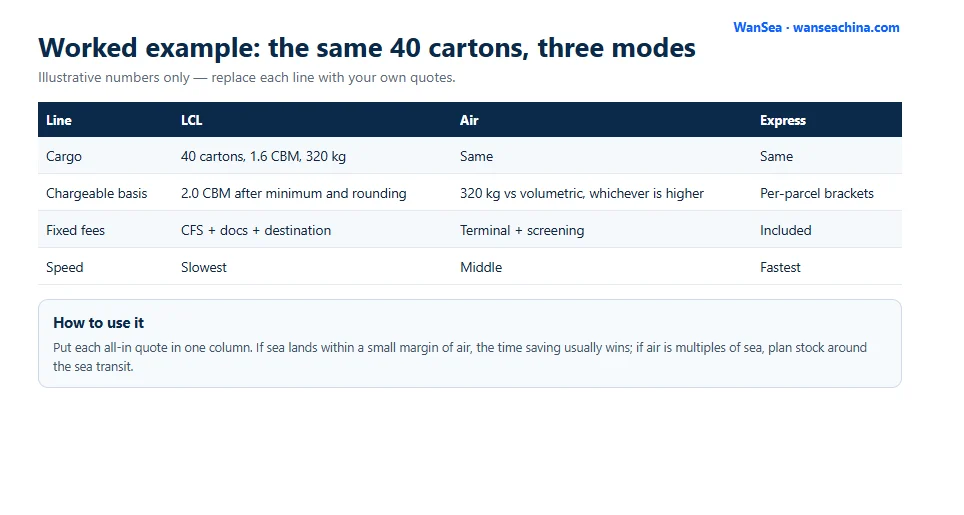
Take the same forty cartons and put them in three columns. In each column, list the chargeable basis, the origin fixed fees, the freight charge, the destination fixed fees and the transit time. Use the provider’s own numbers, not estimates from a rate calculator, and ask each provider to confirm what is included and what is not.
The comparison usually produces one of three answers. If sea is clearly cheapest and the delivery date is flexible, book sea and plan stock around the transit. If air is within a modest margin of sea, take air and protect the selling season. If express is within a modest margin of air, take express and remove the handling risk. What the comparison should not produce is a decision based on the headline rate alone, because the headline rate is the one line that excludes the fixed costs.
The table below is illustrative only; it shows the structure to copy, not prices to expect.
The cost nobody quotes: time
Sea freight from China to the United States or Europe is measured in weeks, and the transit time varies with routing, congestion and the consolidation schedule. Air is measured in days. Express is measured in days with a narrower promise. For a first order, the difference between weeks and days can be the difference between launching on time and missing the window.
Put a value on that difference before you choose. If the goods are for a fixed launch, the faster mode is part of the product cost, and the extra freight is usually smaller than the cost of a missed launch or a discounted clearance sale. If the goods are replenishment for stock you already hold, the slower mode is usually the right answer and the time cost is close to zero. Our LCL shipping overview explains how the consolidation schedule affects the sea transit, and the air freight service page covers the airport-side handling that air quotes include.
What to ask each provider before you compare
Ask for the all-in figure first: pickup in China, export declaration, terminal handling, freight, destination fees, delivery to your address, and the currency. Ask what the chargeable basis is and how it is calculated. Ask what happens if the measured volume or weight differs from the declared figures, and who pays for the difference. Ask for the transit time measured door to door, not port to port.
Then ask the question that separates a real quote from a teaser: what is not included. A provider that answers clearly is easier to compare than one that quotes a single number. If the answer includes surcharges that can change before departure, note them in the comparison and ask for the current level. The express forwarding service en die door-to-door option are useful benchmarks for what a bundled price looks like.
How to spot a teaser quote
A teaser quote has three habits. It shows a single number without the fixed fees. It quotes port to port while you need door to door, so the destination leg disappears from the comparison. Or it quotes a rate that is valid only for a minimum volume you do not have, which means the real price is the minimum, not the rate.
The test is simple: ask for the quote in the same format from all three providers, with the same origin, the same destination address and the same cargo description. If one provider cannot fill in a line, that line is either not included or not known, and both are reasons to ask before you book. Comparing quotes in different formats is the most common way small importers overpay, because the cheapest-looking number is usually the one with the most exclusions.
The Cheapest Mode Is the One With the Smallest Fixed-Cost Stack
The per-kilo or per-CBM rate is not the decision; the minimum charge and the fixed fees are. Before booking forty cartons, collect three all-in quotes on the same basis: one LCL with the shipment minimum stated, one air with the volumetric calculation shown, and one express with the delivery address included. Put the fixed fees on their own line in each column, add the transit time, and only then compare the totals. If one quote looks far cheaper than the others, the missing line is usually the reason. If you want the three quotes built on the same assumptions, send the carton dimensions, weight and destination and we will price them side by side.