Used machinery with oil still inside can usually ship, but not as ordinary cargo without the right paperwork. The booking question is what is left in the tank, lines, sump and hoses: free-flowing liquid makes the unit a dangerous goods question, while a properly drained and cleaned machine usually moves as general cargo with a carrier declaration. Two things decide the outcome, and neither is the machine’s label. The first is documentation that shows the draining actually happened. The second is the destination’s own rules on used equipment, which can be stricter than anything the carrier asks for.
Wat “residual oil” means in booking terms
Carriers are not asking whether the machine is dirty. They are asking whether anything inside it can leak, ignite or react during handling. Free-flowing liquid that can escape through a cap, a fitting or a cracked hose is the concern. A film of oil on internal surfaces is a different situation, and it is usually handled by a draining and cleaning declaration rather than a dangerous goods declaration.
That distinction is why the same machine can be quoted two different ways. A unit that arrives at the warehouse with fuel in the tank and oil in the hydraulic lines needs a different booking, different packing and a different document set from the same unit after a proper drain. If the supplier says “it is empty”, the follow-up question is who drained it, where the liquid went, and what evidence exists.
UN 3166 or UN 3363: the classification question
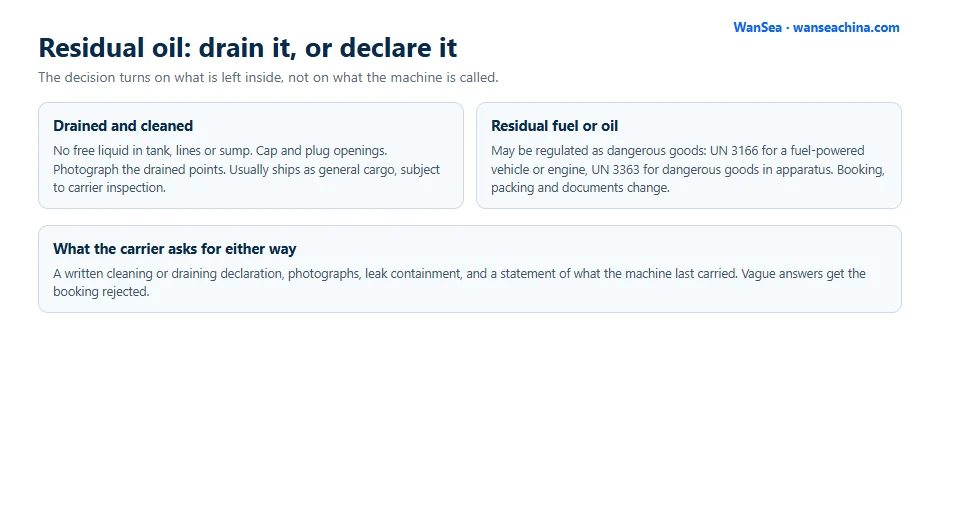
Where residue remains, two UN entries usually come up. UN 3166 covers a vehicle powered by a flammable liquid, which is the entry that applies to a machine that can move under its own power with fuel on board. UN 3363 covers dangerous goods in apparatus or machinery, which is the entry that applies when a regulated substance is contained inside equipment. The correct entry depends on what the machine is, what remains inside, and how much of it there is.
This is not a decision to make from a product photo. The carrier’s dangerous goods desk will want the substance, the quantity, the packaging and the transport mode, and it may ask for a safety data sheet for the residual oil. The IMO’s dangerous goods framework is the starting point for the sea leg; the airline’s rules apply if the machine moves by air, and they are usually stricter. If the machine is drained, cleaned and documented, the dangerous goods question often falls away. If it is not, the booking cannot be completed without a proper declaration.
The draining checklist the factory should follow
Draining is a process, not a single action. Start with the fuel tank: pump it out, then remove the remaining fuel through the drain plug, and dispose of it through a licensed route rather than into the yard. Move to the fuel lines and filter housing, which hold liquid after the tank is empty. Then the hydraulic reservoir and the cylinders, which are often overlooked because the machine looks dry from outside. Finally the sump, the coolant circuit and any oil-filled gearbox that can be drained without damaging the machine.
After draining, cap or plug every opening with a fitting that cannot work loose in transit, not a rag or tape. Clean the external surfaces so an inspector can see there is no seepage, and photograph each drained point with the plug in place. Put absorbent material in the crate and fix the machine so it cannot shift. The photographs are the evidence that ties the declaration to the actual unit, which is why they should be taken at the factory and not at the port.
What happens when the file is incomplete
An incomplete file shows up in three ways. The carrier rejects the booking and asks for the missing document, which costs a day or more and can miss the sailing. The warehouse refuses to receive the unit because it cannot confirm the cargo is not dangerous, which costs storage and a rebooking. Or the shipment moves and the destination authority questions it, which is the most expensive version because the goods are already at the far end of the chain.
None of those outcomes is rare. Used machinery is a category that carriers and terminals watch closely, because a leaking unit damages other cargo and the clean-up is expensive. The declaration and the photographs are not bureaucracy; they are the reason the booking exists at all.
Loading, lifting and securing
A used machine is usually heavier than its dimensions suggest, and the centre of gravity is rarely in the middle. Ask the factory for the lifting points and the weight distribution before the unit is crated, and share them with the forwarder so the loading plan matches the equipment. If the machine has to be lifted by crane, confirm the lifting lugs are rated and accessible through the crate, because a sealed crate with no lifting access invites a rigger to improvise.
Securing follows the same logic. The unit should be fixed to the crate base with bolts or heavy strapping, not blocked with loose timber, and the crate should be designed so the machine cannot move when the container brakes or rolls. For a flat rack or open-top shipment, the lashing plan belongs in the booking documents, not in a conversation at the terminal.
What the carrier asks for before booking
Most carriers ask for a written declaration that the tank, lines and sump have been drained of free liquid, that all openings are capped or plugged, and that the unit is free of leaks. Carriers often add photographs of the drained points and of the crated unit, and some require absorbent material or a containment tray inside the crate. The declaration is signed by the shipper, and a false one is a serious problem, so the factory should complete it rather than the forwarder.
The practical sequence is to drain first, photograph second, crate third, and book last. Booking before the drain is finished is how shipments end up waiting at the warehouse while a carrier asks for evidence that nobody collected. If the machine has hydraulic systems, ask the factory to drain the reservoir and the lines separately, because a drained tank with full hoses still leaks, and a single drain point does not clear fluid trapped in a cylinder.
Destination rules can be stricter than the carrier
Many markets treat used machinery differently from new equipment. Some require an import permit, an inspection before release, or evidence of the machine’s age and condition. Some restrict entire categories of used equipment for safety or environmental reasons. None of that is usually visible in the carrier’s booking system, and none of it is answered by a draining declaration.
The check belongs at the quoting stage: confirm with the destination broker or the importer what the used-equipment rules are for this specific machine and tariff line, and whether a pre-shipment inspection certificate is expected. If the answer is unclear, get it in writing before the unit is crated, because uncrating a machine at destination to satisfy an inspector is a cost nobody budgets for.
Describe the machine consistently in the documents. Used, refurbished and reconditioned are not interchangeable labels, and the customs value and the import permission can turn on which one applies. State the model, the serial number, the year of manufacture, the hours or cycles if the machine records them, and what was replaced during any refurbishment. A destination authority that sees three different descriptions across the invoice, the packing list and the inspection report will ask questions that a consistent file would have avoided.
When the carrier says no
A refusal is usually about evidence, not about the machine. The booking desk cannot confirm that the unit is free of free liquid, so it declines to accept the cargo until someone provides a declaration and photographs that match the unit. Ask which requirement failed, fix that specific item, and resubmit the booking with the new evidence attached.
If the carrier refuses because the machine is regulated as dangerous goods, the answer is not to argue the point. Classify the unit, pack it to the applicable instructions, and book it as dangerous goods with a carrier that accepts the class. Trying to move a regulated unit as general cargo is the version of this problem that ends with the cargo being offloaded.
Wood crating and the ISPM 15 mark
Solid wood crating and pallets are covered by the international phytosanitary standard for wood packaging, ISPM 15. The wood must be treated, typically by heat treatment, and marked with the IPPC symbol, the country code, the producer code and the treatment code. Processed wood, such as plywood or oriented strand board, is exempt from ISPM 15 rather than treated by another method, which is why the crate’s construction matters.
The mark is checked at destination, and a crate without it can be refused, fumigated at the importer’s cost, or destroyed. Ask the crating supplier for photographs of the mark on each piece of solid wood, and keep them with the shipping documents. It is a small detail that turns into a large problem when the machine is sitting at a port and the crate cannot be opened.
The file that travels with the machine
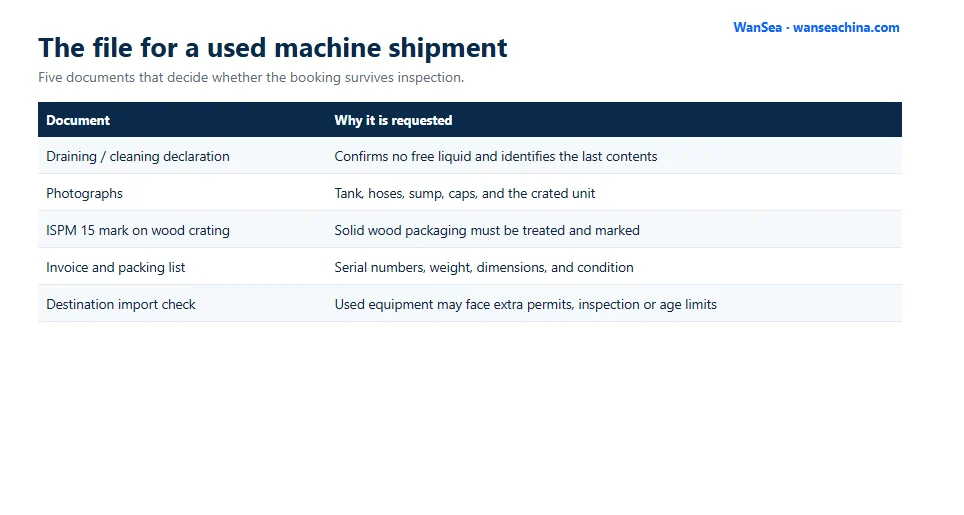
Five documents cover most of the questions. The draining and cleaning declaration identifies what was removed and confirms no free liquid remains. Photographs show the tank, hoses, sump, caps and the finished crate. The ISPM 15 mark proves the wood packaging was treated. The invoice and packing list carry the serial number, weight, dimensions and condition. The destination check records the import rules you confirmed, so the next shipment does not start from zero.
Keep the file in one place and send it with the booking, not after the booking is confirmed. The carrier’s operations team and the destination broker are asking the same questions from different sides, and a single document pack answers both. Our dangerous goods shipping overview covers the declaration side when residue remains, and the China warehouse service explains how crating and consolidation are handled before loading.
Where the schedule usually breaks
The draining and crating work is done at the factory, and it competes with production for the same labour. A machine that was promised for a Friday cutoff often misses it because the drain was scheduled after the crate was built, or because the draining and cleaning declaration arrived without the photographs the carrier wanted. Build two days of buffer into the plan for the drain and the documentation, and confirm the crate is marked before the truck is booked.
The other break is the inspection. If the destination requires a pre-shipment inspection, the inspector needs access to the machine before crating, which means the drain and the inspection have to be sequenced, not run in parallel. Ask the inspection body what it needs to see and in what condition, then give the factory a written sequence. Our customs clearance overview covers the destination side of that handoff.
Drain It, Declare It, Document It
A used machine with residual oil is a document problem before it is a freight problem. Before the booking is confirmed, hold five items: the signed draining and cleaning declaration, photographs of every drained point and the crated unit, the ISPM 15 mark on each piece of solid wood, an invoice and packing list with serial numbers and dimensions, and a written note of the destination import rules you confirmed. If the machine still contains free liquid, stop and classify it under the applicable dangerous goods entry before anyone books space. If you want the file checked before the machine leaves the factory, send the photos and the declaration and we will review them against the carrier’s requirements.