EXW is not just “you pay the truck.” Under Incoterms 2020, Ex Works also hands the export clearance to the buyer, and in China that clearance is the document the export VAT refund is built on: the exporter named on the declaration is the party that claims the refund against the matching VAT invoices. A buyer with no Chinese entity cannot file that declaration alone, so a factory quoting EXW is quietly changing who can recover tax, and at what price. The quotes are not comparable until you price the declaration, the refund and the agent who files it. This guide walks through the handover, the tax layer the usual step tables skip, and how to compare an EXW and an FOB price honestly.
What EXW actually transfers
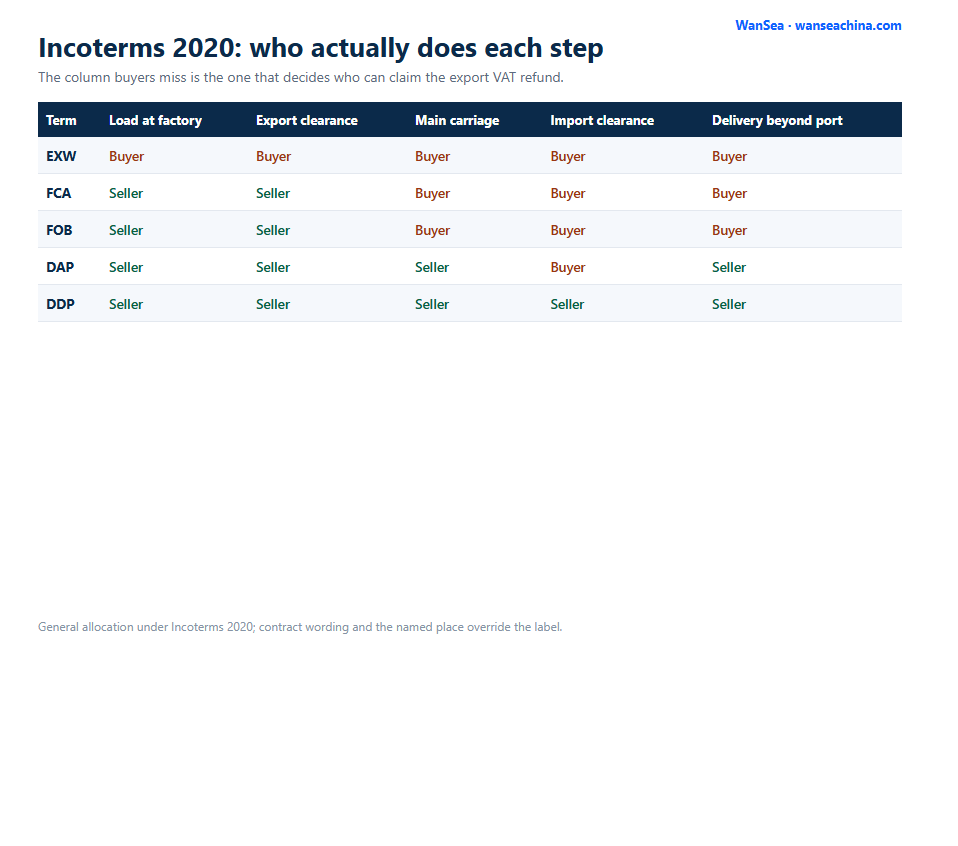
Ex Works means the seller makes the goods available at its premises, packed for export, and does little else. Loading the truck, inland transport, export clearance, terminal handling, the ocean leg and import formalities all sit with the buyer. The seller is not obliged to load, and under a strict reading is not obliged to clear export either.
Factories rarely follow the strict reading in practice. Many will load the truck because it is easier than watching a driver do it, and many will hand over export documents because their finance team needs the sale booked. That gap between the contract label and the daily habit is where the problems start: cost and risk were allocated under EXW, but the paperwork is still sitting on the factory’s desk, and nobody has decided who files it or who claims the refund.
The column the step tables leave out
Most EXW versus FOB comparison tables list the steps and who pays for them. They stop before the line that decides the economics: the export declaration is a tax document as much as a customs form.
China refunds the input VAT on exported goods, and the refund is claimed by the exporter that appears on the export declaration, matched against the VAT special invoices issued along the supply chain. The refund rate depends on the product’s HS code and is set by the State Taxation Administration, which publishes the rules and the refund rate schedule for exported goods. The practical consequence is simple: the refund follows the name on the declaration.
That is where the money becomes visible. The standard VAT rate on most goods is 13 percent, and export refund rates are published by HS code; several of those rates sit below the standard rate. Where that happens the difference is not refunded to anyone in the chain. It is a cost that has to be carried by whichever party is pricing the goods, so two quotes for identical cartons can differ by more than the freight line.
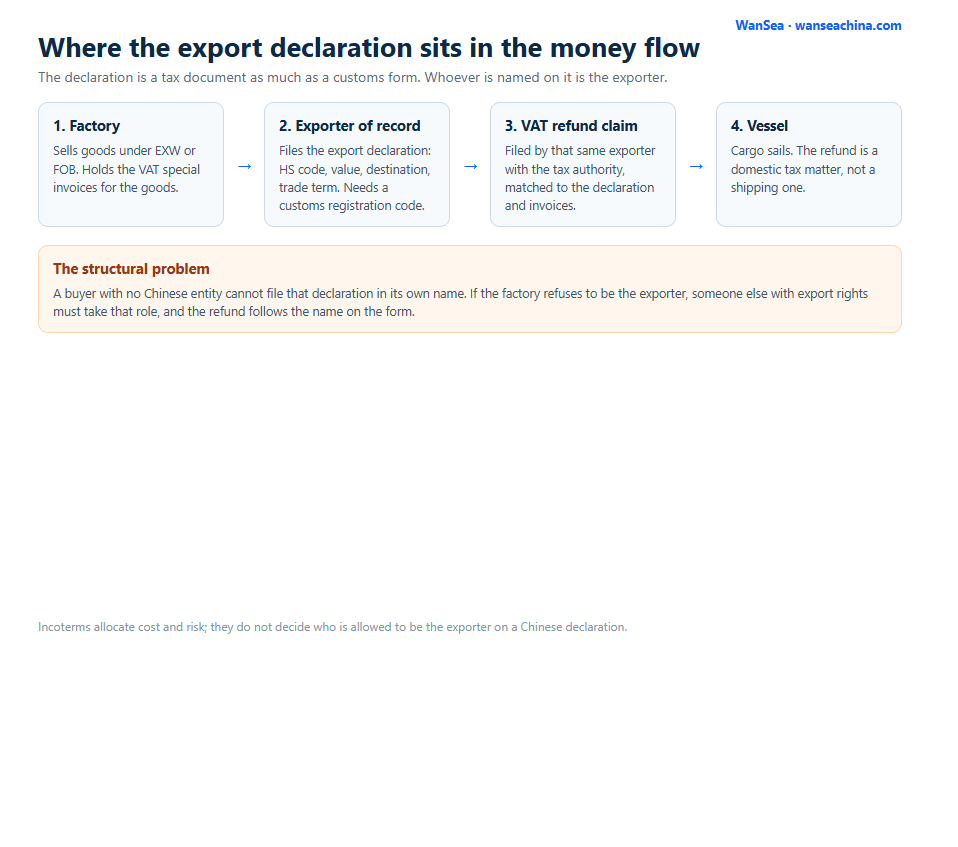
The tax result can be one reason two quotes for identical cartons differ, and the difference stays invisible unless you ask who files the declaration.
Who is allowed to be the exporter
An export declaration in China is filed by a domestic exporter with a customs registration code, using data that must match the goods, the value, the destination and the trade term. A foreign buyer with no Chinese entity cannot put its own name on that form. The role has to be filled by one of three parties, and each choice changes more than the invoice.
The first is the factory. It exports, claims the refund, and sells to you on FOB, FCA or CIF terms. This is the cleanest arrangement for most first-time importers because the party with the VAT invoices is also the party filing the declaration.
The second is a Chinese trading company that buys the goods and exports them in its own name. You contract with the trader, not the factory. The trader controls the declaration and the refund, and its margin usually reflects both the financing it provides and the tax it recovers.
The third is an export agent you appoint. The agent is named as the exporter of record and files the declaration in its own name, usually for a service fee, which means the refund follows the agent rather than you. This works, but it only works if the agreement says in writing who receives the refund benefit, who holds the VAT invoices, and what happens if the declaration has to be amended after filing.
FCA is often the better label for containers
FOB made sense when cargo was lifted over the ship’s rail piece by piece. In container trade the seller hands the goods to a carrier or a terminal before they are loaded, and the ICC has long recommended FCA for containerized cargo for exactly that reason. Under FCA the seller clears export and delivers to the carrier at the named place, and the buyer’s risk starts there rather than after loading.
The label matters less than the habits behind it. If your factory will truck the goods to a consolidation warehouse and clear export, FCA describes that reality better than FOB, and it avoids arguments about who bears risk while the container sits in the yard. If the factory insists on FOB, confirm who pays origin terminal handling and document it in the quote. Our guide to door-to-door and DDP terms covers how far the seller’s responsibility can stretch in the other direction.
The video below walks through a door-to-door shipment from China, which is the structure this article compares against EXW.
When the factory refuses to export
Some factories will tell you they cannot export: no capacity to file the declaration, no exporter role of its own, or a finance team that does not want the workload. That answer is not a dead end, but it changes the structure. You can ask the factory to sell to a Chinese trading company that exports in its own name, with the trader becoming your seller and the refund staying with the trader. You can appoint an export agent who files on your behalf while the factory issues VAT invoices to the agent or to the exporting entity. Or you can change factory, which is sometimes the cheapest option when the order is small and the product is not unique.
Each route has a different failure mode. With a trading company, the risk is that the price hides both the tax recovery and a financing margin, so ask for the export declaration copy and the invoice chain. With an agent, the risk is that nobody agreed who receives the refund benefit before the goods shipped, so the refund stays with the agent of record and your only leverage is the contract. With a new factory, the risk is simply starting over. None of these risks is unusual; what makes them expensive is discovering them after the container has sailed.
The refund is not a discount you can bank on
Importers sometimes treat the export refund as free margin. It is neither free nor fast. The claim is settled only after the declaration is accepted and the documents reconcile, and the timing depends on the tax authority’s review. If the declaration is later amended because the HS code, value or destination was wrong, the refund position has to be corrected too, and the correction can involve repayment.
That is why the refund should be treated as a pricing input that belongs to whoever holds the export role, not as a rebate you can negotiate separately. If a supplier offers you a price that assumes you will “get the tax back”, ask which name is on the declaration. If it is not yours and you have no Chinese entity, the refund is not yours to claim, and the discount was never real.
What changes at the destination
The origin term does not change your position at the destination. You are still the importer of record for the entry, still responsible for the declared value and classification, and still the party customs will call if the declaration is questioned. What changes is the paper trail you can assemble: an EXW shipment exported by an agent may leave you with less documentation about how the goods were declared in China, and that gap matters if the destination authority asks how the value was built.
Insurance follows the same logic. Under EXW the goods are your risk from the factory gate, so cover has to start before the truck is loaded; under FOB your risk starts when the cargo is on board, and the gap in between is the seller’s. Ask which party insures the inland leg before you compare premiums.
This is the practical argument for keeping the origin paperwork complete even when it feels like the factory’s job. The declaration copy, the invoice chain and the packing list are the only evidence that the goods left as described. Without them, a destination query becomes a scramble for documents held by companies you do not control.
What the handover really costs
Three costs hide in the EXW label, and only one of them shows up on a freight quote. The first is the physical leg: trucking from the factory, loading labour, and the terminal handling at origin. A forwarder can quote these, and they are usually visible once you ask for an all-in origin price.
The second is the compliance leg: filing the export declaration, producing the documents the declaration needs, and answering questions if customs selects the shipment for inspection. A forwarder can arrange this through an agent, but the responsibility for the accuracy of the declaration still sits with the exporter named on it, and that is not the forwarder.
The third is the tax leg: the refund. If the party filing the declaration is not the party that carries the VAT invoices, the refund cannot be claimed by the party carrying the cost. This is the cost that makes an EXW quote look cheaper than an FOB quote for the same goods, and it is also the reason some factories quietly refuse EXW once they realise what they would give up.
The document set each side should hold
On the seller’s side, the file should contain the invoice chain that supports the export — an export invoice to the foreign buyer, and the domestic purchase invoices behind it when the seller is a trading company or agent — a copy of the export declaration once filed, the packing list used for the declaration, and the sales contract. Ask for the declaration copy even when you did not file it: it is the record of the HS code, value and destination that the shipment was exported under, and you will need those numbers again at the destination.
On your side, keep the commercial invoice, packing list, bill of lading, insurance certificate if insured, and any certificate of origin used for a preferential tariff. If the goods will be resold or audited, the declaration copy closes the loop between what left China and what arrived. The boundary between what a forwarder handles and what stays with you is set out in this explainer on forwarders and customs.
How to compare an EXW and an FOB quote
Put both quotes on one page and add the same four lines to each: origin trucking and loading, export declaration and agent fees, origin terminal handling, and a note on who receives the refund benefit. Then add your destination costs, which do not change with the origin term.
If the EXW total plus those lines lands below the FOB total, the EXW offer is genuinely cheaper and worth taking, provided someone accountable is filing the declaration. If it lands above, the difference is usually the tax cost sitting in the chain, and the FOB price is the honest one. What you should not do is compare the product price alone, because the product price is the one line that never includes the declaration.
Two questions separate a workable arrangement from an expensive one. Who is named as the exporter on the declaration, and who holds the VAT invoices that the refund depends on. If the answers point to different companies, get the arrangement in writing before the goods leave the factory, not after the invoice arrives. Our customs clearance overview covers the destination side of the same chain.
What to confirm before you accept an EXW quote
Ask five things in writing before you approve the order: who files the export declaration and under which customs registration; who holds the VAT invoices and who receives the refund benefit; who loads the truck and who pays for it; what the all-in origin cost is, including terminal handling and documentation; and which party answers if customs inspects the shipment. If any answer is “we will sort it out later”, treat the quote as incomplete. The label on the invoice is not the arrangement; the arrangement is what you can prove when the container is already at the port. If you want the comparison on one page, send the EXW quote and the carton list, and we will price the origin leg, the declaration and the all-in FOB equivalent side by side.