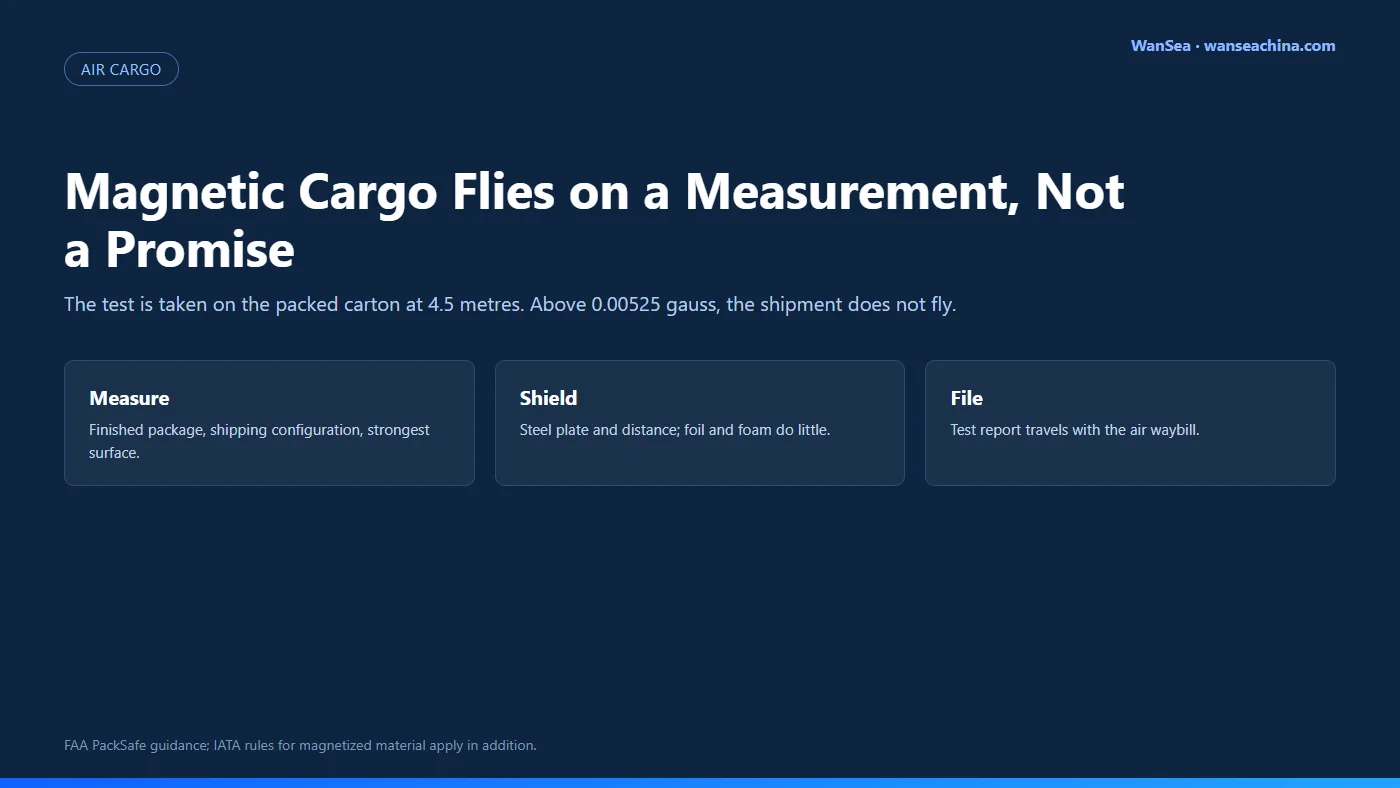
Products with strong magnets can fly, but only if the packed box passes a field measurement. The test is not about the magnet’s strength on a datasheet; it is about the magnetic field at 4.5 meters (15 feet) from any surface of the package as it will be tendered. US aviation rules say a package or magnet that exceeds 0.00525 gauss at that distance cannot be carried by aircraft. Below the limit, the shipment can usually move, subject to the carrier’s own acceptance rules and a test report that records the measured field. If the box fails, a label does not fix it; the packing or the mode has to change.
The limit is measured, not estimated
The threshold is a physical measurement with a fixed distance, and both parts matter. A field that is harmless at arm’s length can exceed the limit at 15 feet if the magnet is large or the package geometry focuses the field. That is why a supplier’s statement that “the magnet is weak” is not usable evidence: weak compared with what, measured where, in which orientation.
The rule exists because a magnetic field can affect aircraft instruments and compass systems. The FAA guidance on shipping magnets states the 0.00525 gauss limit at 4.5 m and explains that packages above it cannot fly at all. The same threshold sits behind the ICAO and IATA rule: magnetized material above the limit is forbidden for air carriage, not merely documented. Below the limit the shipment moves as non-restricted cargo, and the test report is the evidence the carrier accepts.
What the test measures and why packing changes the answer
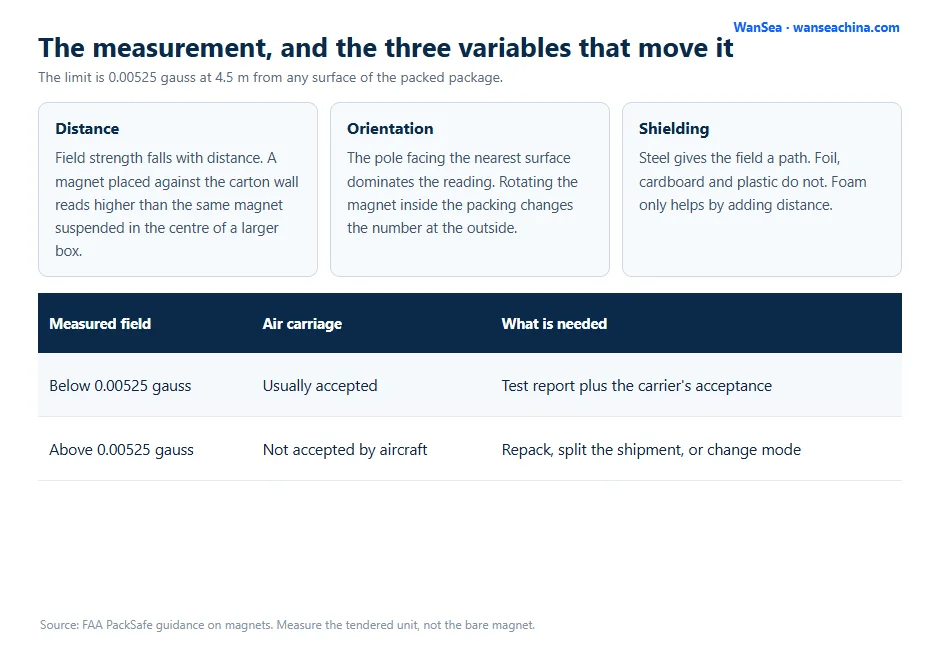
The measurement is taken on the outside of the finished package, in the shipping configuration, with the goods packed as they will travel. Three variables move the result: distance from the magnet to the box surface, the orientation of the magnet inside the carton, and the material between the magnet and the outside world. A magnet packed against the wall of a thin carton reads higher than the same magnet suspended in foam in the center of a larger box.
Test the heaviest and largest unit in the shipment, not an average sample. A pallet with several cartons stacked together can produce a stronger combined field than a single carton, and the measurement is taken from the outside surface of whatever unit is tendered. If the goods ship as a pallet, the pallet is the package for this purpose.
Shielding: what works and what is wishful thinking
Steel is the practical shielding material, because it gives the field a path to follow instead of letting it radiate. A steel plate or a steel-lined inner box placed on the side with the strongest reading reduces the external field, and the reduction is measurable. Aluminum foil, cardboard and plastic do almost nothing, and foam only helps by increasing distance, which is why the same magnet reads lower in a bigger box.
The sequence that works is measure, shield, measure again. Shielding without a second measurement is a guess, and a guess is what the airline’s acceptance staff will reject. If the second reading is still above the limit, add distance or reduce the magnet’s effective size in the package, and measure a third time. Two or three iterations are normal for a new product; a repeat shipment can reuse the tested configuration and its report.
The file the airline asks for at acceptance
Chinese carriers and ground handlers commonly ask for a test report from a testing body rather than a supplier declaration. The report identifies the goods, the package configuration, the instrument, the distance and the measured field, and it is what lets the forwarder book the cargo as non-restricted, or decline it. Without it, the booking may be accepted and the cargo refused at the counter, which is the expensive version of the same problem.
Turnaround varies by laboratory and city, so book the test before the booking request rather than after the space is confirmed, and keep the report with the shipment documents and match it to the packing. A report for a single carton does not cover a pallet, and a report for one model does not cover a different model with a larger magnet. If the packing changes, the measurement changes, and the report has to be redone. Our dangerous goods service covers the wider document set that sits around this test.
What the test report must contain
A usable report is specific enough that a booking clerk and an airline can both rely on it. It names the product and model, describes the package dimensions and the magnet position inside it, states the instrument and its calibration, records the distance of 4.5 meters, the measured field at the strongest surface, and whether the package sits below the limit for air carriage. A report that gives a single number with no package description is not usable, because the number cannot be tied to the box in front of the clerk.
Ask for the report in English, or with an English summary, since the airline’s acceptance team and the destination may both read it. Keep it with the air waybill and the packing list, and send the same document to the forwarder with the booking request. Our air freight service explains where acceptance sits in the airport sequence, which is the point at which the report is actually checked.
How the booking changes when cargo is magnetized
A consignment with magnets is booked with one extra document, even when the field is far below the limit. The forwarder needs the report before the booking request, because the acceptance team has to know whether the shipment is magnetized material or not, and the answer changes the handling and the documents. If the report arrives after the space is booked, the booking may have to be amended, and an amendment close to cutoff is where shipments lose their flight.
The practical sequence is: product specification and magnet position from the factory, packed-carton measurement, report, booking request with the report attached, acceptance, then trucking. Each step depends on the one before it, and the trucking step is the one that cannot be undone if the report is wrong. A forwarder in China who asks for the measurement before quoting is telling you the sequence will hold.
Samples and small parcels
A single carton of samples is still a magnet shipment, and courier screening follows the same physics. Small parcels are screened by machine and by hand, and a parcel that reads above the limit is stopped whether it was sent as a sample or a production order. The report matters more for samples, not less, because a sample sent without one can be returned at your cost while the customer waits.
If the sample is the first unit of a new product, test it in the packing you intend to use in production. A sample packed loosely in foam and a production carton with the goods pressed against the wall are different measurements, and the second one is the one that will be repeated a thousand times.
What a label does and does not do
Orientation arrows and a magnetized-material marking tell handlers how the carton should sit and warn them that the contents produce a field. They do not lower the field, and they do not substitute for the measurement. A carton marked “keep away from magnetic media” that reads above the limit is still a carton that cannot fly, and the marking may even draw the attention that ends in a refusal.
Use the marking where the carrier or handler asks for it, because it flags the orientation for handlers and keeps the carton away from magnetic media, then treat it as the last step rather than the fix. The order is measure, shield, measure, pack, mark, book. A shipment built in that order rarely fails at the gate, and the file it produces answers the airline’s questions in one pass.
When the shipment fails at the gate
A failed measurement is not the end of the order, but it is the end of that booking. The cargo cannot be flown in that configuration, and no amount of paperwork changes the physics. The practical options are to repack and retest, to split the shipment so the magnetic items travel separately with proper shielding, or to change mode.
The cost of a gate refusal is not just the freight. The cargo has already been trucked to the airport, screened and booked, and the airline may charge for the handling and for the space it held. A report that was correct for the previous carton size does not cover a new one, which is why a packaging change mid-season resets the test. That is why the measurement belongs at the packing stage, before the truck leaves the factory, not at the airport counter on the day of departure.
Products that catch people out
Loudspeakers are the classic case, because the driver magnet is large and the cabinet does not shield it. Magnetic phone mounts, magnetic toys, door seals, motors, magnetic tools and some furniture hardware behave the same way: the product is not sold as a magnet, but it contains one. A shipment described as “speakers” with no mention of the magnet will be booked as general cargo and stopped at screening.
Ask the factory for the magnet specification with the packing details, and treat any product with a permanent magnet as a candidate for testing until a measurement says otherwise. The question to put to the supplier is not “is it magnetic” but “what is the field at 4.5 meters from the packed carton”, because the first question invites an opinion and the second requires a measurement.
Sea and rail as the fallback
Magnetic cargo that cannot meet the air limit often moves by sea without the same field restriction, subject to the carrier’s own stowage rules, because the vessel’s systems are not affected the way an aircraft’s are. The trade-off is transit time, and for a product launch or a replenishment shipment that trade-off may be unacceptable. Express couriers apply their own acceptance rules and are not a loophole; a parcel that fails an airline’s test can fail a courier’s screening too.
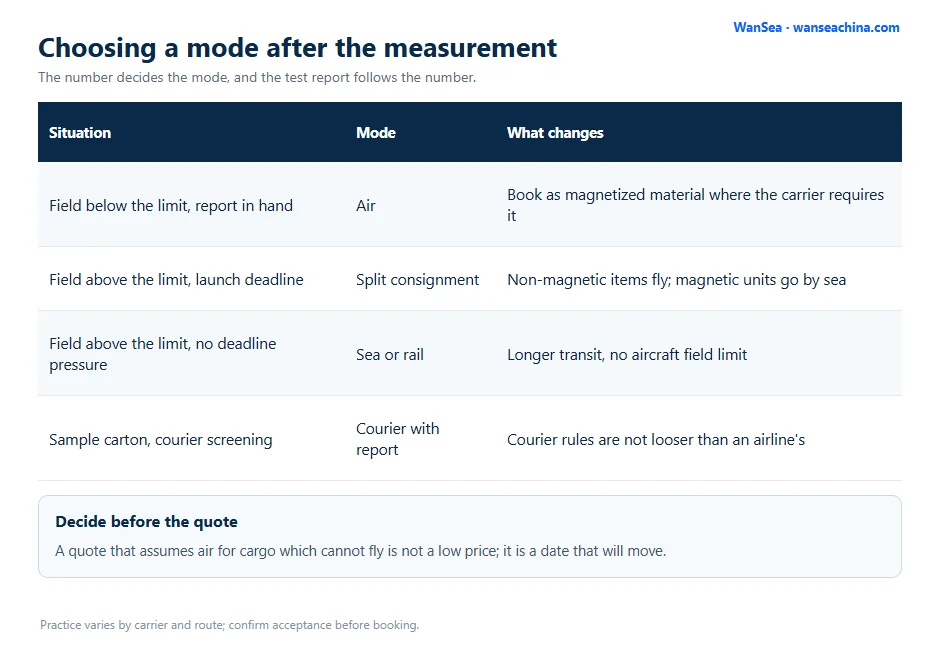
The decision rule is simple enough to apply at quotation stage: if the measured field is below the limit, air is available with the report; if it is above, plan sea or rail and stop quoting air. Getting that answer before the customer commits to a delivery date is worth more than any freight rate.
Test the Packed Box, Not the Magnet
Magnet shipments are decided by a measurement of the finished package, and everything else follows from that number. Below the limit, the shipment needs a test report and a booking that states the measured field. Above it, the cargo does not fly, and the only useful responses are repacking, splitting the consignment or changing mode.
Before the next quotation, ask the factory for the packed-carton measurement at 4.5 meters and the test report that supports it. If neither exists, book the test before the booking request, and treat the result as the first line of the shipping instruction rather than the last.