You can ship a car with personal belongings inside, but not under the rules most people find online. Those rules describe domestic auto transport: a suitcase in the trunk, an allowance some US auto transporters advertise at about 100 lb, no valuables. An international container shipment from China is a different problem, because the car and the contents are two separate customs matters and two separate insurance matters, and many carriers refuse the contents outright. The workable path has five parts: written carrier approval, a declared weight and volume limit, a signed inventory with hazardous goods removed, a destination check, and an insurance position you can live with. Anything less turns a convenient move into a customs hold at the far end.
Why domestic advice does not transfer
Domestic auto transporters move cars between states on trucks. Their allowances exist because the truck driver can inspect the car at pickup and because a domestic move does not cross a border. An international shipment involves an export declaration in China, an ocean or rail leg, and an import entry at destination, and the contents inside the car have to be described somewhere in that chain. A rule written for a domestic truck does not answer the question a foreign customs officer will ask.
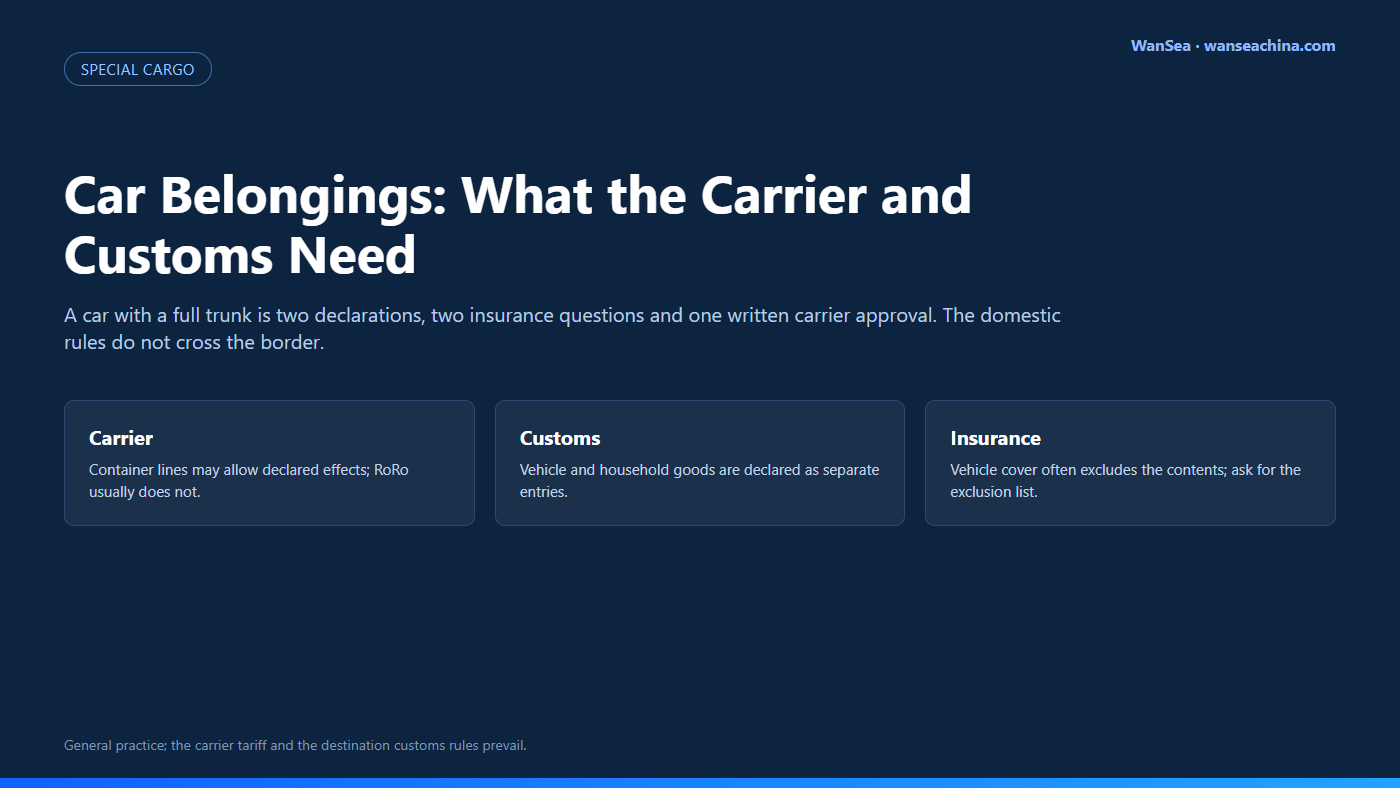
The practical difference is the declaration. A car is declared as a vehicle with a make, model, year, identification number and value. Personal effects are declared as household goods or personal property, with their own description, value and often their own import conditions. When the two are mixed into one line on a customs form, the entry becomes ambiguous, and ambiguous entries are more likely to attract questions.
Carrier approval comes first
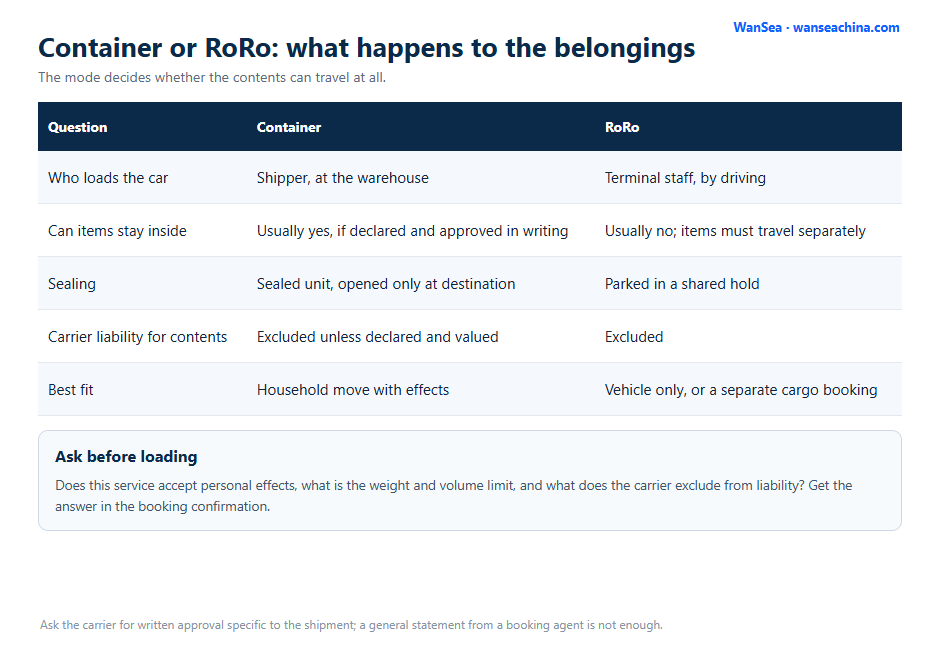
Container lines and RoRo operators treat the contents differently. A container can be sealed with goods inside, so some carriers allow a limited amount of personal effects provided the shipper declares them and accepts that the carrier’s liability does not cover them. RoRo shipments usually prohibit anything inside the vehicle, because the car is driven on and off and the contents are not secured for that handling. The approval has to be in writing and specific to the shipment, not a general statement from a booking agent.
Ask three questions before loading anything: whether the carrier accepts personal effects in this service, what the weight and volume limit is, and what the carrier excludes from liability. The weight of the contents also feeds the container’s verified gross mass, which is declared separately and has its own tolerance, so a limit that is respected inside the car can still be breached on the booking. Get the answers in the booking confirmation. If the answer is no, the contents travel as a separate consignment, which usually avoids a port-side dispute. Our sea freight service page describes how a container booking is built, including the declarations that go with it.
What you can and cannot put in the car
Anything that would be dangerous goods as loose cargo is dangerous goods inside a car. Aerosols, solvents, fuel in cans, propane cylinders, lithium batteries not installed in a device, and cleaning chemicals all raise the same questions they would raise in a normal carton, and hiding them inside a vehicle does not change the classification. Remove them before the car is delivered to the warehouse.
Leaks are the next risk, because they damage the interior and, worse, the vehicle’s electronics during a long ocean voyage. Cooking oil, a half-empty cleaning bottle or a jerry can left in the trunk will slosh for weeks. Pack nothing that can spill, and if you must include a liquid, seal it in a secondary container and declare it. Weight distribution then matters: heavy items loaded on one side change the way the car sits on the container floor and how it is lashed.
Customs treats the two as separate declarations
At export, the vehicle is declared as a vehicle, and any effects inside it are declared under the export treatment the Chinese authorities require. At import, the destination decides whether the contents enter as household goods, and many destinations handle that under a separate declaration: in the United States, for example, unaccompanied personal effects are declared on CBP Form 3299, which asks for an itemized list rather than a single value. Some destinations restrict used household goods, require an inspection, or grant a duty concession only for a first relocation.
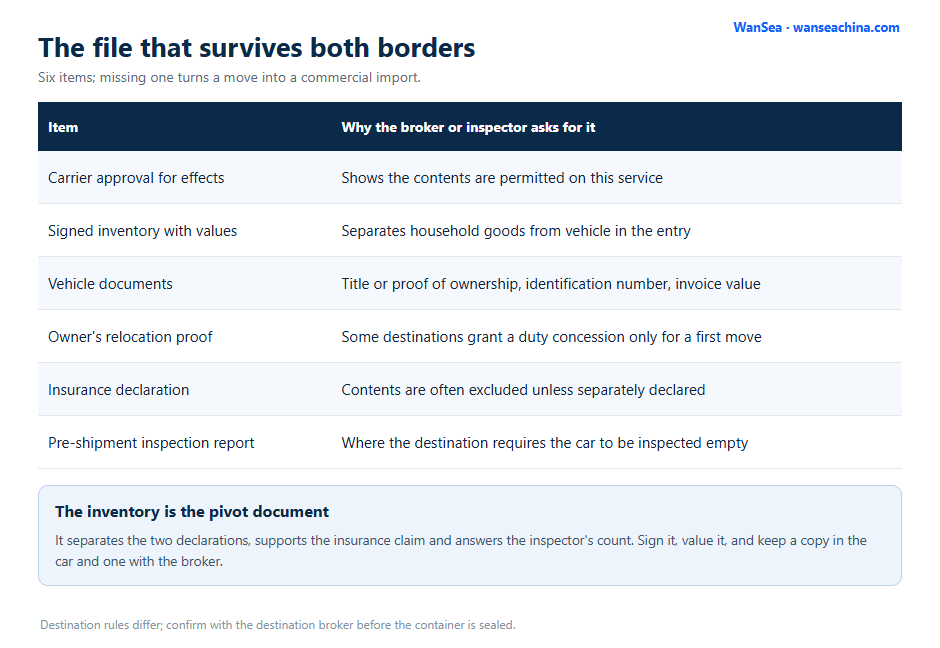
That is why the inventory matters. A list with quantities, descriptions and values, signed by the owner, is the document that lets the destination broker separate the two declarations cleanly. A vague list, or no list, forces the broker to guess, and guessing is how a personal move becomes a commercial import with duty attached.
The video below shows how a warehouse consolidates and secures cargo before loading, which is the stage where a vehicle and its contents are checked against the inventory.
The destination vehicle rules still apply
Nothing about the belongings changes the vehicle’s own import conditions. Age limits, emission standards, left-hand or right-hand drive requirements, safety inspections and import permits are set by the destination, and they apply to the car whether or not anything is inside it. The US rules for importing a car are a useful example of how much documentation a vehicle entry can require, and most destinations have an equivalent set.
Check the vehicle rules before you check the belongings rules, because a car that cannot be imported makes the contents question irrelevant. If the destination requires a pre-shipment inspection, an inspector normally wants to see the car empty, which means the belongings have to be loaded after the inspection, not before.
Insurance rarely covers what is inside
Vehicle insurance for the ocean leg usually covers the vehicle, not the personal property inside it. A cargo policy may cover the effects if they are declared and valued, but many policies exclude household goods or apply a low sub-limit. Ask for the exclusion list in writing and check whether the contents need a separate declaration and premium. If the policy is silent, treat the contents as uninsured and decide whether that risk is acceptable.
The practical test is the claim. If the car arrives with a broken window and a missing box, the insurer will ask what was in the box, what it was worth, and whether it was declared. A file with an inventory, photographs and a declared value answers those questions. A file without them turns a small loss into an uninsured one.
Packing and lashing the load
Belongings inside a car move during the voyage, and a loose box can damage the interior or the vehicle’s electronics. Pack items into soft bags or cardboard, place them in the trunk and the rear footwell, and avoid the seats and the dashboard. Do not block the driver’s view or the controls, because the car may need to be moved at the terminal. Photograph the loaded car before it is sealed.
The car itself has to be secured to the container or the vessel in the way the carrier requires, and the lashing points must remain accessible. A car packed to the roof with boxes may not be securable, which is another reason to keep the load light and low. If the carrier provides a loading plan, follow it exactly; if not, ask who is responsible for lashing and what evidence they will provide. A warehouse that handles vehicles will normally photograph the loaded unit and record the lashing points on the file.
When the car travels by RoRo
Roll-on/roll-off vessels load cars by driving them aboard, which is faster and often cheaper than a container, but the handling is different in ways that matter for the contents. The car is moved by terminal staff, sometimes repeatedly, and it is parked in a hold with other vehicles. Anything loose inside can move, fall or be taken, and many operators prohibit personal effects for exactly that reason.
If the quote is RoRo, assume the car ships empty unless the operator confirms otherwise in writing. A container gives you a sealed unit that only you, the terminal and the destination authorities open, which is the main practical reason to pay for a container when the belongings matter. The trade-off is cost and the need for a container loading plan.
What the destination broker needs
The destination broker is the person who turns your paperwork into an entry. Many importers hand the vehicle, the container and the entry to one freight forwarder in China, with a broker at the destination, and the handoff works when the file reaches both of them early. Give them the vehicle documents, the inventory, the carrier’s approval, and the insurance certificate before the vessel arrives, not after. A broker who sees the file early can tell you whether the destination treats the contents as household goods, whether a relocation certificate is needed, and whether the vehicle needs an inspection that has to happen before the car is loaded.
Ask the broker one direct question: what would make this entry fail. The answers usually fall into three groups: missing ownership proof for the vehicle, an inventory that does not match what is inside, or a destination rule that restricts used household goods. Each of those is fixable before departure and expensive after arrival.
Common reasons these shipments get held
An undeclared item comes first in the list: a box that appears in an inspection but not on the inventory suggests the declaration is incomplete, and the whole entry slows down. Prohibited items are next, usually a small aerosol, a fuel can or a battery pack that the owner forgot was in the car. Then there is the mismatch between the vehicle documents and the physical car, such as a different identification number or a color change that was never recorded.
The last category is a destination rule the shipper never checked, for example an age limit on imported used vehicles or a requirement for a pre-shipment inspection. None of these is exotic; they are the normal failure modes of a move that was planned around the freight quote instead of around the customs file. A short checklist applied before booking prevents most of them, and it costs nothing compared with a container sitting at a destination terminal while the entry is corrected.
Two consignments, one container
A container can hold the car and a separate consignment of belongings packed in cartons beside it, which avoids the carrier’s objection to items inside the vehicle. This structure has two practical advantages: the belongings are declared as cargo with their own packing list, and the car ships empty, which satisfies operators that prohibit contents. Which party arranges the two bookings depends on the trade term, and the export paperwork split decides who files the declaration at origin. The disadvantage is volume: the cartons take space the car cannot use, and the container may need to be larger than a single-vehicle load.
If the volume is small, the cartons can travel as LCL and the car as a separate booking, meeting at the destination warehouse. That keeps each consignment simple and lets the car ship on the cheapest suitable service. The decision is arithmetic: compare the cost of the extra container space with the cost of a second shipment and the risk of a carrier refusal at the last minute.
What to confirm before the container is sealed
Before the doors close, confirm five things in writing: the carrier’s approval for personal effects on this service, the weight and volume limit, the inventory with values signed by the owner, the destination’s vehicle and household goods rules, and the insurance position for the contents. Then photograph the loaded car, keep the inventory with the shipping documents, and give a copy to the destination broker. If any answer is missing, unload the car and ship the belongings separately; that decision is cheaper before the seal than after the arrival notice.