
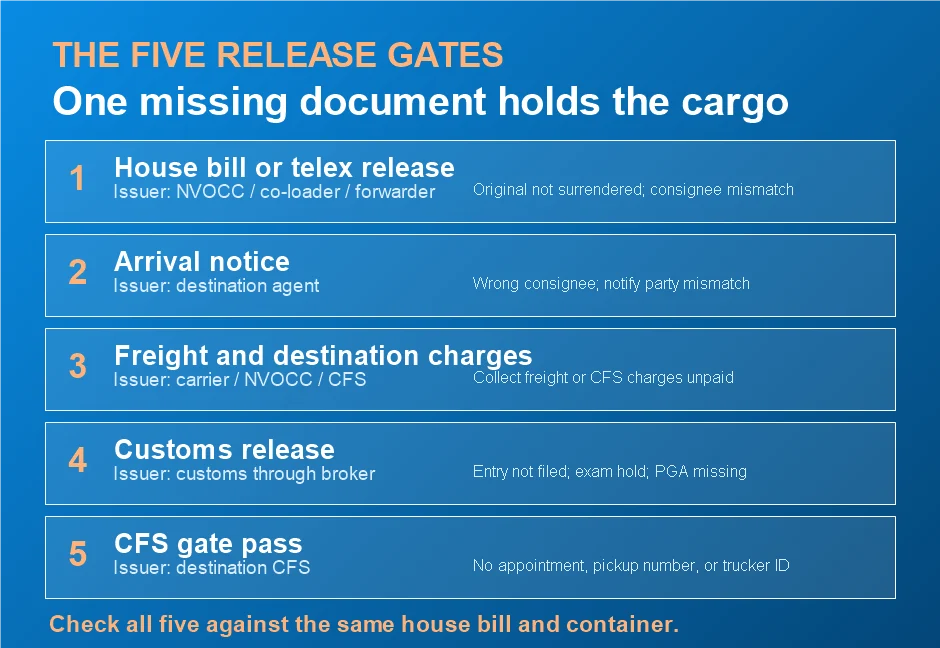
LCL cargo does not leave the destination CFS because the vessel was discharged. It leaves when five separate gates are cleared: the house bill is released, the arrival notice matches the consignee, the freight and destination charges are settled, customs has released the entry, and the CFS has issued a gate pass. A missing gate does not stop the whole container. It stops your cartons while storage and per-day charges keep running. Each document comes from a different party, and the CFS will not accept one as a substitute for another. This guide maps the five documents, who issues each one, what blocks it, and the single email that gets a straight answer before your trucker arrives.
The Release Chain Has Five Gates, Not One
An LCL container is discharged as one unit, but it is released as many shipments. The destination CFS devans the container, separates the cargo by house bill, and holds each shipment until the release conditions on that bill are met. The CFS is a warehouse, not the carrier. It does not decide who owns the cargo, and it does not clear customs. It checks that the paperwork it has been given authorizes it to hand the cargo to your trucker.
That is why a single missing document can hold a shipment that has already arrived. The container is on the ground, the cargo is physically available, and the CFS still will not open the gate. The five gates below are the sequence a release agent usually works through.
| Gate | Document | Who issues it | What it proves | What commonly blocks it |
|---|---|---|---|---|
| 1 | House bill of lading or telex release | NVOCC, co-loader, or forwarder that issued the house bill | Who is entitled to take delivery | Original bill not surrendered; telex release not sent; consignee name mismatch |
| 2 | Arrival notice | Destination agent or co-loader | Which shipment, container, CFS, and free time apply | Wrong consignee, notify party treated as consignee, missing arrival notice |
| 3 | Freight and destination charge settlement | Carrier, NVOCC, destination agent, or CFS | That the release party has been paid what its terms require | Collect freight unpaid; destination charges disputed; duplicate invoice |
| 4 | Customs release | Customs authority through the licensed broker | That the government has cleared the entry | Entry not filed; exam hold; missing importer bond or PGA data |
| 5 | CFS gate pass or pickup authorization | Destination CFS | That the named trucker may remove the cargo | No appointment; no pickup number; trucker lacks ID or plate details |
The order is not cosmetic. A CFS may issue a pickup number before customs releases the entry, but it will not let the truck load. A customs broker may release the entry before the house bill is surrendered, but the destination agent will not issue the delivery order. Each gate has its own owner, and each one can be checked separately.
Gate 1: The House Bill of Lading or Telex Release
The house bill of lading is the contract between you and the party that sold you the LCL service. It names the shipper, consignee, notify party, cargo description, piece count, port of loading, port of discharge, and the terms that govern the move. The ocean carrier’s master bill covers the whole consolidated container and is issued to the NVOCC or co-loader, not to each LCL shipper. An NVOCC issues its own house bill without operating the vessel, as the Federal Maritime Commission explains. If you booked through a forwarder that does not operate the consolidation, there may be two house bills in the chain: one from your forwarder to you, and one from the co-loader to your forwarder.
The destination agent releases against the bill it was told to release against. A common failure is a buyer who holds a house bill from its own forwarder while the destination agent is holding a different house bill from the co-loader. The cargo is on the same container, but the release instruction is in the wrong file. Before the vessel arrives, confirm the house bill number the agent will use, the consignee name exactly as printed, and whether the bill is original, telex released, or a seaway bill.
An original bill is a document of title. The carrier or agent will not release the cargo until the full original set is surrendered, unless the bill has been telex released or converted to a seaway bill under the issuer’s procedure. A telex release confirms that the original set has been surrendered and the destination may release without it. A seaway bill is non-negotiable from the start. These are different mechanisms, and the destination agent will ask for the one that matches the bill.
Under a letter-of-credit or documents-against-payment sale, the shipper may hold the original bill at origin. If the shipper has not surrendered it or requested a telex release, the buyer has no lever at the destination CFS and must chase the shipper, not the CFS. Ask the shipper to confirm the release instruction before the vessel sails.
Check the on-board notation as well. A bill marked “received for shipment” confirms that the carrier took the cargo, not that it was loaded on the named vessel. A bill marked “shipped on board” confirms loading. Release can proceed with either, but a buyer who needs proof of sailing should ask for the on-board date and vessel.
Gate 2: The Arrival Notice and the Consignee Match
The arrival notice is the destination agent’s operational notice. It usually shows the house bill number, container number, vessel and voyage, CFS name and address, cargo availability date, free-time expiry, and the charges that must be settled before release. It is not a release document by itself, but it is the document that tells you which CFS and which release desk to deal with.
Compare four names before you pay anything: the consignee on the house bill, the importer of record on the customs entry, the delivery address on the trucking order, and the party named on the arrival notice. If they differ, the release desk needs a written authorization or a corrected document. A notify party is not the consignee, and a trading company that buys the goods is not automatically the importer of record.
Name mismatches are boring and expensive. A missing “Ltd.”, a different address, or a parent company named as consignee while the entry names a subsidiary can all trigger a hold. The fix is usually a corrected bill or a letter of authorization, but it takes time. Ask for the arrival notice as soon as the vessel departs, not after it arrives.
Gate 3: Freight and Destination Charges
The CFS and the destination agent release against their own commercial terms. The delivery order is the agent’s instruction to the CFS to release the cargo to the named party, issued after the bill is surrendered or telex released. If the freight is collect, the carrier or NVOCC will not release until it is paid. If the CFS’s destination charges — deconsolidation, delivery order, documentation, terminal handling, and storage — are unpaid, it can refuse to hand over the cargo where local law or the CFS contract gives it a lien. This is not a customs issue and not an ownership issue. It is a payment condition in the release contract.
Ask for an itemized invoice tied to the house bill and container number. The useful breakdown separates pass-through charges from the agent’s own service fees and shows the calculation basis: per house bill, per cubic meter, per revenue ton, per day, or a minimum. If a charge appears twice, or a destination charge was already included in a DDP or delivered quote, raise it before paying. Free time usually starts when the cargo becomes available after devanning, not on vessel arrival.
Do not confuse “freight prepaid” with “all destination charges included.” A prepaid ocean bill can still leave CFS handling, delivery order, terminal, brokerage, and trucking to the consignee. A CIF or CFR quote covers the ocean leg, not the destination warehouse release.
Gate 4: Customs Release
Customs release is separate from commercial release. The example is the US import process; other destinations run their own entry system, but the separation from commercial release is the same. The broker files the entry (CBP Form 3461) to obtain release, with the importer’s bond covering duty at that stage. The entry summary (CBP Form 7501) is filed after release, within the 10-day window CBP specifies, and is where duties are declared and paid. The customs system returns a release, a hold, or an exam instruction. The CFS, or the agent instructing it, confirms release before cargo goes. A broker’s email or payment receipt is not a customs release.
Three customs issues commonly stop an LCL release. The entry may not be filed because the importer of record has no bond or the broker is missing a document. The entry may be selected for an exam, which means the container or the shipment must be moved to an inspection area. The entry may be held by a partner government agency that needs a permit or certificate. In each case, the CFS cannot override customs, and storage continues.
The broker and the destination agent are different parties. The broker answers to customs; the agent answers to the bill of lading and the CFS. A release number from the broker is useful only when the CFS can see it in its system. Ask the broker for the release date and entry number, then ask the CFS to confirm the release is visible on the house bill.
Gate 5: The CFS Gate Pass and Trucker Appointment
The last gate is physical. The CFS needs a pickup authorization, a delivery order, a trucker appointment, and the identity details of the truck and driver. Some CFS facilities issue a pickup number or gate pass after the delivery order and customs release are confirmed. Others require the trucker to book a loading dock slot before the truck arrives. The exact sequence is set by the CFS, not by the carrier.
Give the trucker the house bill number, container number, CFS address, pickup number, appointment time, piece count, and the release contact. The driver should carry a photo ID and the plate number on the booking. If the cargo is on pallets, confirm whether the CFS will load the truck or only place the pallets at the dock.
Count the pieces at pickup. The CFS tally and the house bill should match the carton or pallet count. Note any damaged packaging, wet cartons, or missing pieces on the pickup document before the driver signs. If the count is short, ask the CFS to record the shortage on the gate pass and photograph the remaining cargo before it leaves.
The Release Email That Gets a Straight Answer
Many release delays are caused by unclear questions. A release desk handles many house bills, and a vague “please advise status” email can sit behind specific requests. Send one email with the facts and ask for the blockers in writing.
- House bill number, master bill number, container number, and vessel/voyage
- Consignee name exactly as printed, plus the customs importer of record
- CFS name, cargo availability date, and free-time expiry
- Whether the original bill is surrendered, and whether the delivery order is issued
- Whether customs has released the entry, and the entry number
- Itemized destination charges, the pickup appointment, and the trucker details
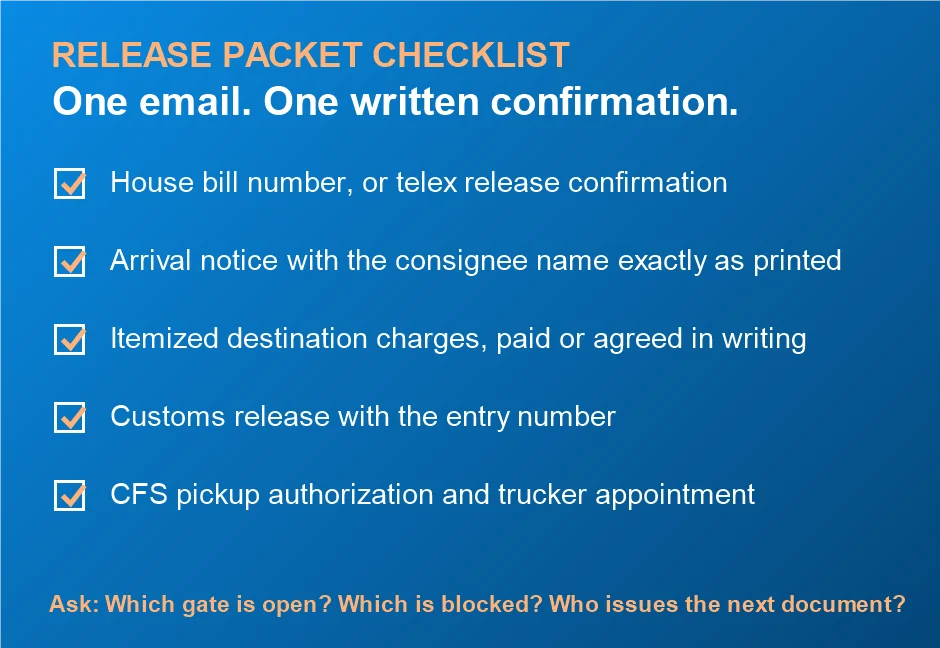
Then ask four direct questions: which gate is open, which gate is blocked, which document the release desk needs next, and who issues it. Ask for a written reply with a name and a deadline. If the answer is “waiting for customs,” ask for the entry number and release date. If the answer is “waiting for payment,” ask for the invoice and the amount that must clear. If the answer is “waiting for the bill,” ask whether a telex release or bank guarantee is acceptable and who must approve it.
Five Matches Before the CFS Releases the Cargo
Release is a matching problem: five documents, one bill, one container. Before the trucker leaves, put five items together: the house bill or telex release confirmation, the arrival notice with the correct consignee, the paid destination charge invoice or written payment agreement, the customs release with the entry number, and the CFS pickup authorization with the trucker appointment. Send them in one email and ask the desk to confirm in writing that all five match the same house bill and container.
If you are booking LCL from China, start with the LCL service page and check the cost and damage controls before the cargo leaves. If a destination invoice looks larger than the quote, use the CBM dispute method before you pay. For a small order where the mode is still open, compare the fixed costs in the forty-carton example.
الخطوة التالية: send the house bill number and the CFS name to فريقنا before the vessel arrives, and we will check which of the five release gates is still open.