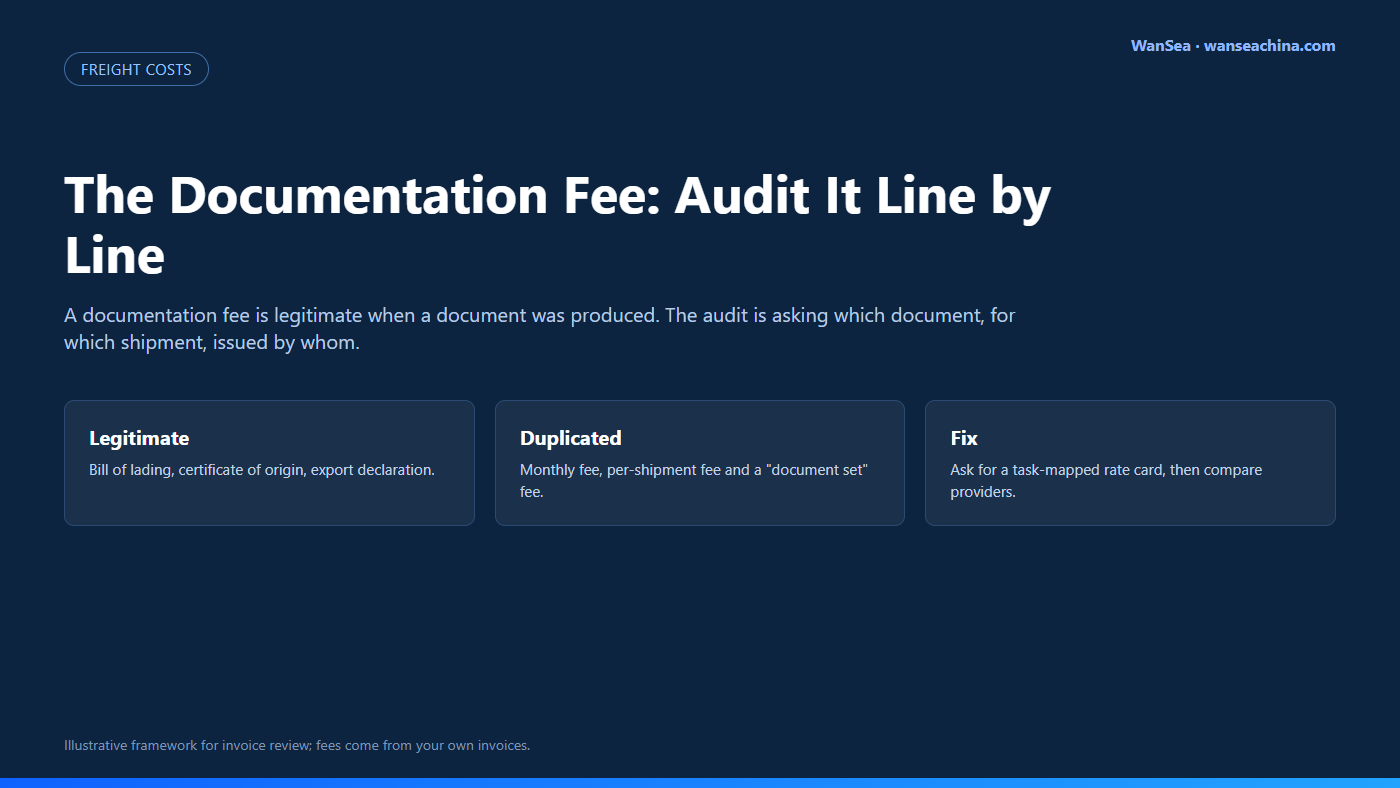
A documentation fee is usually not a payment for documents. It is a charge for the forwarder’s time, systems and liability in producing and handling paperwork, and a recurring fee that appears without a line-by-line explanation is the easiest charge on the invoice to question. The way to audit it is to separate two things that are often blended: disbursements the forwarder actually pays to a third party, such as a chamber of commerce or a carrier, and the administrative margin attached to handling them. One is evidenced by a receipt; the other is a commercial price you can negotiate.
What the fee is actually for
Export documentation is not one task. It is a set of tasks: preparing the commercial invoice and packing list, checking the shipping instructions, issuing or arranging the bill of lading, filing the export declaration, obtaining certificates, and answering questions when a document is queried. A forwarder bundles that work into a fee because charging by the minute is not practical. The fee is legitimate, but it is not self-justifying, and the scope should be visible.
Two features separate a fair fee from a padded one. The first is whether the fee changes when the workload changes: a shipment with one document set should not carry the same charge as a shipment with five amendments and a certificate request. The second is whether the same work is charged twice under different names, which is the pattern worth looking for when a recurring fee sits beside per-shipment line items.
Disbursements that genuinely cost money
Some documents carry a real third-party charge. A certificate of origin is often certified by a chamber of commerce or a trade promotion body, and that body charges for the certification. The International Chamber of Commerce guidance on certificates of origin describes what the certification covers, which is useful when a forwarder presents one line for the certificate and another for handling it. A phytosanitary or health certificate is issued by an authority that charges for inspection and issuance. A fumigation certificate works differently: the treatment is normally carried out and certified by a licensed treatment provider, which charges for the treatment itself, and the forwarder may add a handling charge on top. Consular legalization, where required, involves a consulate fee. A bill of lading amendment after issuance usually carries a carrier fee, and a telex release carries its own charge.
Those are disbursements. The audit question is simple: can the forwarder show the third-party invoice or receipt for the amount billed. A forwarder that cannot produce a receipt for a “certificate fee” is not necessarily acting in bad faith, but the charge should then be treated as part of the commercial fee and negotiated as such, not presented as a pass-through.
Charges that tend to be counted twice
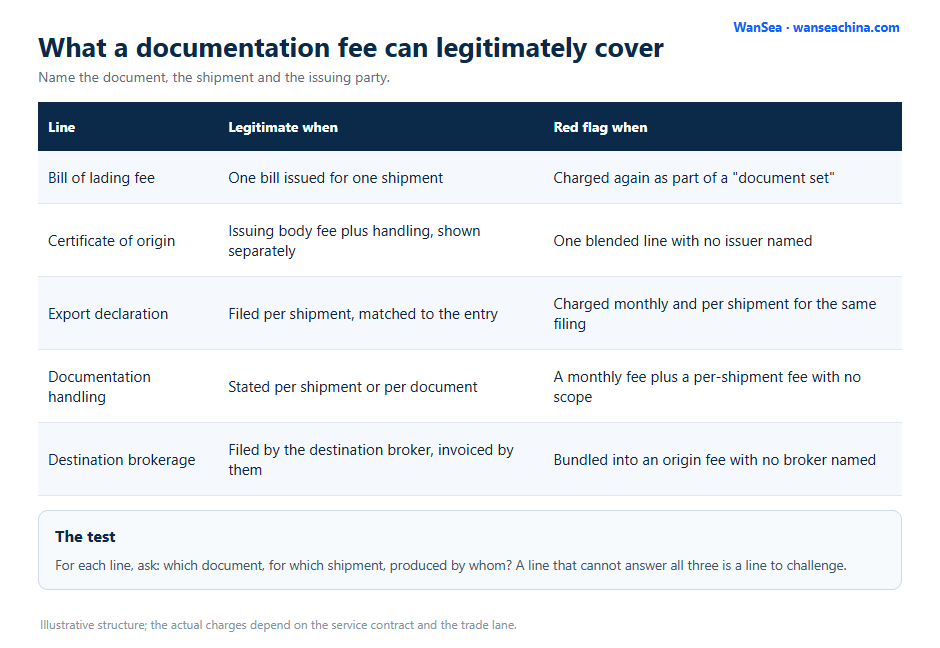
The duplication that shows up first is a documentation fee plus a separate bill of lading fee plus a separate “set of documents” fee, all covering the same output. Another is an export declaration fee that reappears as a customs clearance fee on the same shipment. A third is an amendment fee applied to a correction the forwarder itself made, rather than to a change requested by the shipper.
The pattern is not always deliberate. Forwarders inherit rate cards from different departments, and a recurring admin fee may have been introduced after the per-shipment fees were set. The point of the audit is not to accuse but to put the lines side by side and ask which one covers the work. A forwarder that can explain the split is easy to keep; one that cannot is charging for confusion.
What a certificate of origin actually involves
A certificate of origin looks like one page, but the work behind it is not one page. The exporter has to establish the origin criterion, collect the supporting production and material records, complete the form in the required format, submit it to the issuing body, and answer any query the body raises. If a preferential origin claim rests on it and the certificate turns out to be wrong, the duty that was waived can be recovered at destination, which is why the issuing body checks before it stamps.
Two charges are legitimate here: the issuing body’s certification fee, which is a disbursement, and the forwarder’s or agent’s handling fee for preparing and submitting the application. A single line that says “certificate fee” without distinguishing the two should be split before you accept it. It is also the line most likely to be padded, because few importers know what the issuing body actually charges.
When the documentation fee hides a broker fee
At destination, the customs broker files the entry and charges for it. That is a separate service from the forwarder’s export documentation, and it should appear on a separate invoice or at least a separate line. When a forwarder presents a single “documentation and clearance” charge that covers both ends, the importer cannot see which party did what, and the destination broker’s own fee becomes invisible.
The practical consequence is a comparison problem. Two forwarders quoting the same headline fee may be including different amounts of broker work, so the cheaper quote can be the more expensive one once the destination invoice arrives. Ask each provider to state what the fee covers at origin, what it covers at destination, and which party issues the entry. The answer tells you whether you are comparing the same service, and how a forwarder’s role differs from a broker’s is set out in our note on who handles customs at each end.
The video below shows the origin pickup and delivery operation that the documents travel with. The documentation fee covers the paperwork for that leg, not the transport itself.
The pattern of duplication, line by line
Take an invoice with three documentation lines on one shipment. Written out in the four columns below, the overlap becomes visible without any dispute about the amounts.
| Charge | Basis | Third-party cost | Document it relates to |
|---|---|---|---|
| Documentation fee (forwarder) | Per shipment | None stated | Commercial invoice and packing list set |
| Bill of lading fee (carrier, billed through the forwarder) | Per bill of lading | Carrier charge | One original bill for the same shipment |
| “Set of documents” fee (forwarder) | Per shipment | None stated | Described as the same file |
Row one and row three now describe the same output. Row two is a real carrier charge, but it is not evidence that the other two are different work. If all three relate to the same shipment and the same document set, the importer is paying three times for one output, and the test is not the name of the charge but the work behind it: who prepared the documents, who issued the bill, and what the third charge adds.
Ask the forwarder to map each line to a task. A provider that can do it will usually consolidate the lines on the next invoice. A provider that cannot is either disorganized or comfortable with the ambiguity, and both are reasons to move the file to a provider that itemizes. The audit does not require an accountant; it requires the invoice, the file, and a short email.
Ask for the itemization in a fixed format
Request the invoice in four columns: charge, basis, third-party cost, and the document it relates to. Basis means per shipment, per bill of lading, per certificate or per amendment. Third-party cost is the amount actually paid out, with the receipt attached. The document column is what turns the invoice into something an operations person can verify against the file.
Do this for one month before negotiating anything. A single month shows which charges recur, which are one-off, and which appear on every shipment regardless of the documents involved. Recurring charges are the ones a contract clause can address; one-off charges are the ones to check against the receipts.
The contract clauses that prevent the argument
Three clauses do most of the work. The first lists the documents included in the fee, by name, so that “dokumentation” has a definition. The second sets the price for documents outside the list, such as a certificate of origin or an amendment, and says whether those are charged at cost plus a fixed handling fee or at a flat rate. The third states that a disbursement must be supported by a third-party receipt, and that charges without a receipt are treated as part of the commercial fee.
If the forwarder resists a list, ask for the standard rate card instead and attach it to the contract. A rate card is not as good as a scope definition, but it is better than an open-ended fee, because it at least fixes the price of the common items. Review it once a year, on the same cycle as the freight contract rather than on a separate date that nobody owns.
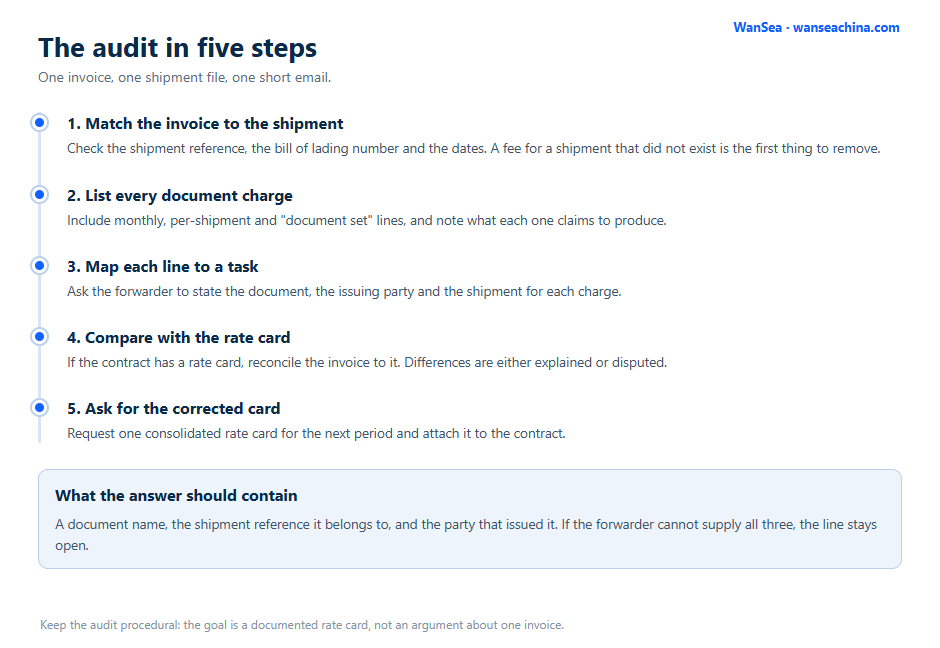
How to run the audit in five steps
First, pull twelve months of invoices and tag every line that mentions documents, certificates, declarations or amendments. Second, group the lines by name and count how often each appears. Third, ask for receipts for the lines presented as third-party costs. Fourth, compare the totals with the quote you signed and with the rate card, if one exists. Fifth, list the charges that have no receipt and no clear basis, and put that list to the forwarder in writing with a request for explanation, not an accusation.
The output of the audit is shorter than most importers expect: the duplicated lines, the charges that should have been quoted but were not, and a clear picture of which documents actually cost money on your trade. That is enough to renegotiate the fee or to move the business, and it is done once rather than argued shipment by shipment.
Turn the audit into a rate card request
Send the list to the forwarder with a short covering note asking for an explanation and a corrected rate card. Keep the tone procedural: the goal is a document that shows what is charged for what, not a refund. Five items make the request hard to answer vaguely: the invoice numbers you reviewed, the lines you could not map to a document, the lines presented as third-party costs without a receipt, the document set you actually need next quarter, and the price you are asking them to confirm for each item in that set.
If the answer is satisfactory, attach the corrected rate card to the contract and review it annually. If it is not, the same list becomes the specification you send to two other providers when you ask for a quote, and you can compare their answers line by line instead of comparing headline fees.
When a fee is fair even when it looks high
A documentation fee can be high and still be fair. A shipment with a certificate of origin, a legalization, a fumigation certificate and two amendments involves real work and real disbursements, and a flat fee that covers all of it may be cheaper than itemized charges. The test is the comparison, not the number: what would the same documents cost itemized, and what does the flat fee include.
The same logic applies to a low fee. A fee that looks cheap may exclude the certificate work, which then appears later as a separate charge. The only reliable comparison is the total cost for a defined document set, not the headline fee on the first invoice.
How this fits the rest of the invoice
Documentation is one block of a freight invoice, and it should be reviewed with the others. The origin charges, the freight, the destination charges and the accessorials each have their own audit logic, and a fee that looks reasonable in isolation can be the symptom of a quote that was never itemized. Our ocean freight service page shows how a booking is priced, which is the context the documentation line sits in.
Ask these four questions about every fee
Before you approve the next invoice, ask four things: what document does this charge relate to, is any part of it paid to a third party, can the third-party part be supported by a receipt, and what did the quote say about this item. If the answers are clear, the fee is doing its job. If they are not, the fee is a negotiation item, and the file you build from the answers is the same file that protects you if the charge is ever disputed.