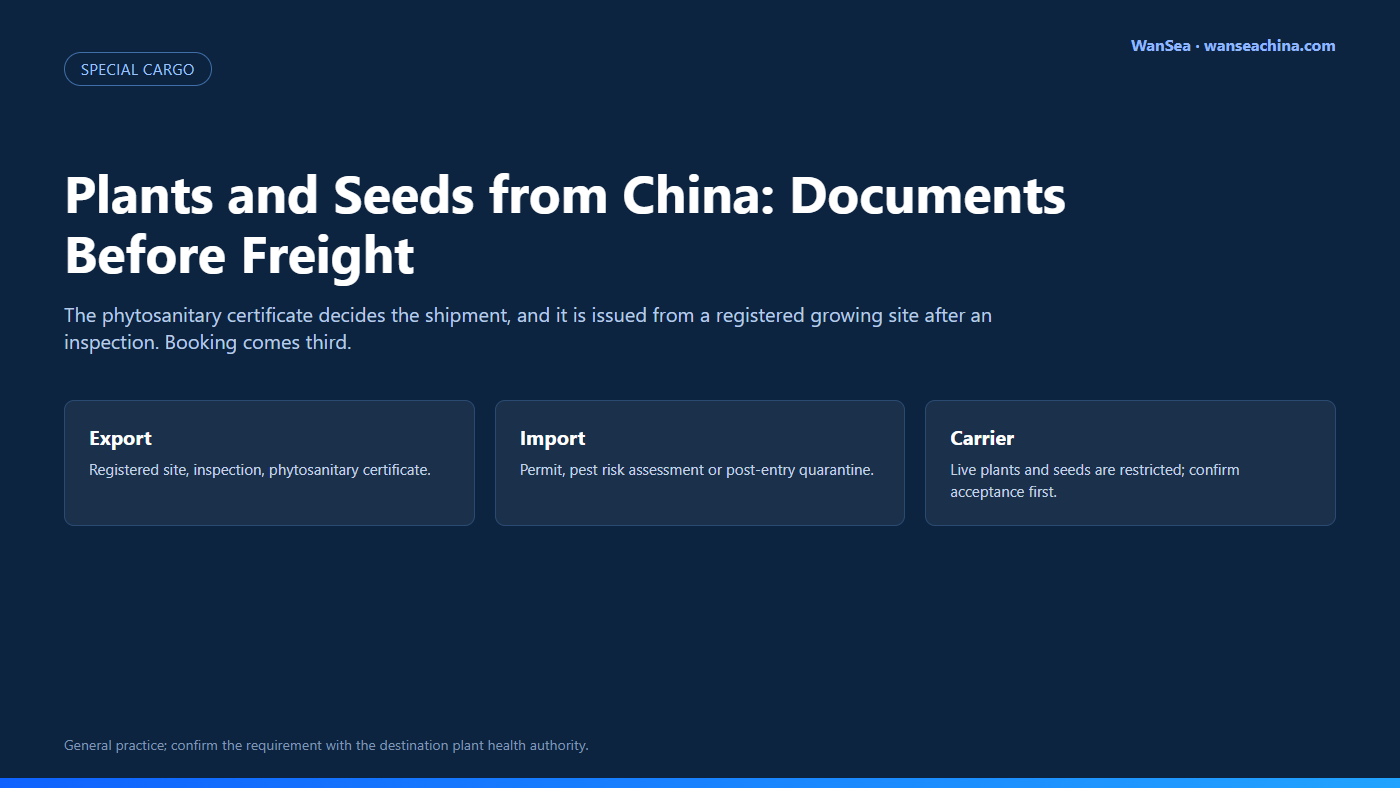
Shipping plants or seeds from China is less a freight problem than a documentation problem, and the document that decides the shipment is usually issued before the goods reach the airport. Live plants, cuttings, bulbs and many seeds require a phytosanitary certificate from the Chinese plant health authority, and that certificate is issued after an inspection of a pest-free consignment, and in some markets only from a registered growing site. The destination then adds its own layer: an import permit, a pest risk assessment, or a requirement for post-entry quarantine. Freight is the last thing to arrange, not the first.
What counts as “plants” for this purpose
The category is wider than potted plants. It includes seeds, seedlings, cuttings, buds, bulbs, tubers, fresh herbs, cut flowers, and any plant product that can carry a pest. It also includes products with soil attached, which are often treated as a higher risk than the plant itself, and wooden packaging, which is covered by a separate standard. A shipment described simply as “decorative plants” gives the inspector nothing to match against the permit, and vague descriptions are one of the reasons a consignment is held for clarification.
What the goods are determines which certificate is needed and which authority issues it. Fresh plants and seeds generally need a phytosanitary certificate. Processed plant products, such as dried herbs for consumption or roasted seeds, may fall under food safety rules instead. A product with both characteristics, such as edible seeds intended for planting, can need both a phytosanitary certificate and a food safety check, and the importer is the party who has to know which applies.
The export side: registration before certification
Some destination protocols require the production site to be registered before a certificate can be issued for goods from that site. The importing market decides whether that applies: the EU, for example, sets additional requirements for certain plants and plant products that come from registered production sites in the exporting country, which is part of its plant health regime. Where registration applies, it covers the growing area, the pest management practices and the packing facility.
This is why the export conversation should start with the grower, not the forwarder. Ask whether the growing site is registered for the destination country, whether the species is eligible for that market, and what inspection records exist. If the answer is that the site is not registered, no amount of freight planning will produce a certificate, and the shipment will either be refused at export or held at destination. For goods covered by that requirement, a trading company that buys from unregistered growers cannot obtain a certificate; the site itself has to be eligible.

The certificate itself
A phytosanitary certificate is issued by the competent plant health authority in the exporting country, and in China that is the General Administration of Customs (GACC), whose plant quarantine function covers the inspection and the certificate. It states the identity of the plants, the quantity, the growing location, the treatment applied if any, and a declaration that the consignment meets the importing country’s requirements. The certificate is not a form the exporter fills in and signs; it is issued after an inspection, which is why the timing has to be planned around the inspection, not around the flight.
The certificate usually has a validity period, and the goods must leave within it. A certificate issued too early expires before the shipment departs, and one issued too late misses the flight. The practical rule is to book the inspection when the goods are packed and ready, then book the flight for a date inside the certificate’s validity. A common cause of delay is reversing that order.
Destination requirements: permit, assessment, quarantine
Many countries require an import permit for plants and seeds before the goods leave the exporting country, and the permit often names the species, the quantity and the port of entry. Some species require a pest risk assessment before a permit is issued, and some are prohibited outright. The importer usually applies for the permit, and the exporter needs the permit number to complete the phytosanitary application in some systems.
Beyond the permit, destinations may require post-entry quarantine, growing-on tests, or inspection at a designated facility. Those requirements change the delivery address and the timeline: the goods may not go to the importer’s warehouse at all, but to a quarantine station, and the carrier has to be told. A shipment addressed to the wrong place is a shipment that sits while the paperwork is corrected.
Carrier acceptance is not automatic
Many airlines and express operators restrict live plants and seeds, and some refuse them entirely on certain routes. The reasons are practical: plants need ventilation, they can leak or shed, and a consignment that is refused at the gate disrupts the aircraft’s load plan. The carrier’s acceptance has to be confirmed before the goods are packed, not at the counter.
Air is the usual mode for live plants because transit time matters and ventilation can be controlled. Sea is possible for bulbs, tubers and some seeds, which tolerate a longer voyage if they are packed to avoid condensation and rot. Express can work for small, high-value seed shipments, but the operator’s restrictions are often stricter than an airline’s, so check both the service and the route. The choice is driven by the species’ tolerance, not by the freight rate, and our air freight service page covers the airport handling side for time-sensitive cargo.
Packing that survives inspection
Packing has to allow inspection without destroying the consignment. An inspector normally needs to see the plants, count them and check for pests, so a sealed box with no access is a problem. Use ventilated cartons, label each species and quantity, and keep the packing list inside the carton as well as outside. Do not add soil unless the destination permits it, and if a growing medium is required, use a sterile or approved medium and say so on the documents.
Treatments, if required, must be recorded and matched to the certificate. A fumigation certificate that lists a different quantity or species from the phytosanitary certificate creates a discrepancy that takes time to resolve. Pack treated and untreated goods separately, and keep the treatment record with the shipping documents rather than in an email thread.
The document set
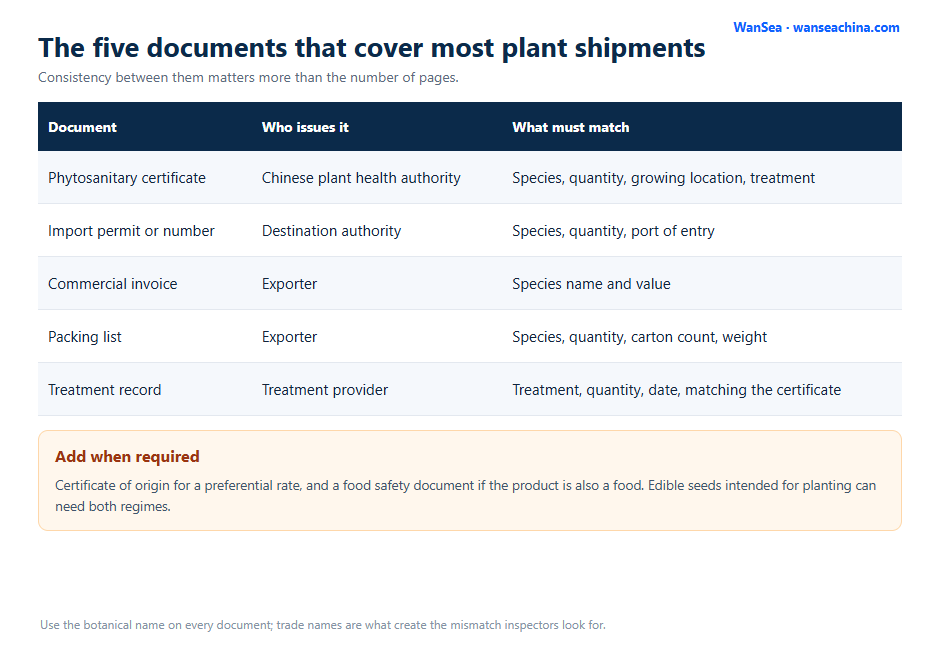
Five documents cover a typical plant shipment: the phytosanitary certificate, the import permit or its number, the commercial invoice, the packing list with species and quantities, and the treatment record if a treatment was applied. Add a certificate of origin if the destination grants a preferential rate, and a food safety document if the product is also a food. The IPPC standard on phytosanitary certification systems sets out what a certificate is meant to attest, which is useful when the destination’s requirements are unclear.
Keep the documents consistent. The species name on the certificate, the invoice and the packing list must match, and the quantity must match the physical count. Inspectors are trained to look for the mismatch, because a mismatch is the simplest sign that the consignment was assembled from more than one source. Our सीमा शुल्क निकासी सिंहावलोकन covers the entry side, which is where the plant documents are checked against the permit.
What usually goes wrong
A frequent failure is a shipment prepared before the permit exists. The plants are packed, the flight is booked, and then the importer discovers that the destination requires a permit or a risk assessment that can take weeks or longer, depending on the authority. The second is a certificate for the wrong species, usually because the commercial name and the botanical name were used interchangeably. The third is a carrier that accepts the booking but refuses the cargo at the gate because the route or the packaging does not meet its rules.
Each failure has the same fix: confirm the destination requirement, the certificate, and the carrier acceptance before the goods are packed. That sequence costs a few days at the start and saves the consignment. It also makes the freight quote meaningful, because the quote assumes a shipment that can actually fly.
How the inspection actually runs
The phytosanitary inspection is usually done at the packing site or at a designated inspection point, before the goods are handed to the carrier. The inspector checks the identity of the plants, the quantity, and visible signs of pests or disease, and may take samples. If the consignment matches the application, the certificate is issued; if it does not, the goods are held until the difference is corrected or the shipment is rejected.
That is why the packing date and the inspection date should be the same day where possible. Goods packed on Monday and inspected on Thursday have had three days to be moved, mixed with other stock, or exposed to something the inspector will notice. Record the inspection date on the file and give the certificate to the carrier with the other documents, not in a separate email that arrives after the cutoff.
Cost items to ask about
Plant shipments carry cost items that a general freight quote leaves out. Ask about four of them, and ask what each one is charged on: the inspection and certification charge (usually per consignment), the treatment cost (usually per treatment run or per cubic meter treated), the handling of the goods at the airport or port if they need ventilation or special staging (often per day), and the destination inspection or quarantine fee (usually per consignment, billed by the destination agent). Add the cost of losing a consignment that fails inspection, which is not an invoice line but is the reason the process is worth doing properly.
None of these items is optional if the destination requires the underlying step. A quote that omits them is not a cheaper quote; it is an incomplete one, and the missing items will appear on a later invoice or as a delay. Ask for the quote to show the phytosanitary and treatment items as separate lines so they can be checked against the destination’s requirements.
Where to start when the species is new to you
If you have not shipped the species before, start with the destination authority’s plant import database or the equivalent list of regulated species. Many countries publish which plants and seeds need a permit, which are prohibited, and which need quarantine. Match the botanical name, not the trade name, because the trade name is what the catalogue uses and the botanical name is what the regulation uses.
Then ask the grower three questions in writing: whether the site is registered for that destination, whether the species is on the destination’s permitted list, and what treatment history the site has. The answers tell you whether the shipment is possible at all. A forwarder can arrange the freight, but no forwarder can make an ineligible species eligible.
Book the inspection before you book the freight
The order is the whole lesson. Before asking for a freight rate, confirm five things: the botanical and commercial name of the species, whether the growing site is registered for the destination, whether an import permit or risk assessment is required, whether the carrier accepts live plants or seeds on the route, and which treatments, if any, are required. If any answer is unknown, the quote is provisional. Get the answers in writing from the grower, the destination authority and the carrier, and keep them with the shipment file. If you are comparing providers, ask each one to describe the inspection sequence before they quote; our forwarding team answers that question first. A plant shipment that clears is one where the inspection date was fixed before the flight date.