L'assurance d'un fournisseur que votre produit est “non soumis aux AD/CVD” is not a customs classification. Antidumping and countervailing duty coverage is decided by the scope language of an order, and only a scope ruling from the Commerce Department settles it. If the entry turns out to be covered, the importer of record carries the duty, and U.S. Customs and Border Protection can investigate the entry as evasion under the Enforce and Protect Act. That investigation can hold open entries you already filed and require a single transaction bond. The supplier’s promise does not move any of that risk.
What the promise actually covers
Suppliers usually mean one of three things when they say the product is not covered: the HTS code is not on the order list, the factory has never paid AD/CVD on it, or a competitor’s product was excluded. None of those answers the legal question, because an AD/CVD order defines covered merchandise by scope language, not by tariff line alone.
Scope language often describes the product by material, dimensions, manufacturing process, end use, and sometimes by exclusion. A product can share an HTS code with covered goods and still fall outside the scope, and a product can sit in a different HTS code and still fall inside it. Customs can also look behind the code: if the entry description, origin or production route does not match what the scope requires, the code alone will not protect the file.
Why the importer carries the exposure
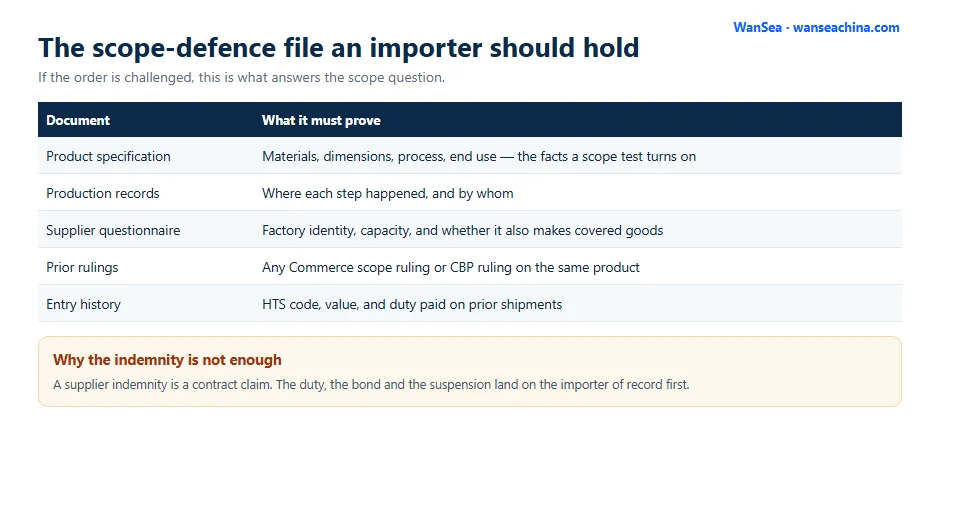
The importer of record is the party that owes the duty and the party customs notifies. A supplier indemnity is a contract claim against a company in another jurisdiction; it does not stop liquidation, bonding or penalties at the border. That asymmetry is the reason the verification work belongs to the buyer before the order is placed, not to the factory after the invoice is issued.
There is also a practical trap in the paperwork. If the entry declares one origin and the production records show another, the discrepancy is exactly the kind of material false statement the evasion statute describes. Even an innocent mismatch can turn a routine entry into a review that takes months and freezes the goods.
What EAPA changes once an allegation lands
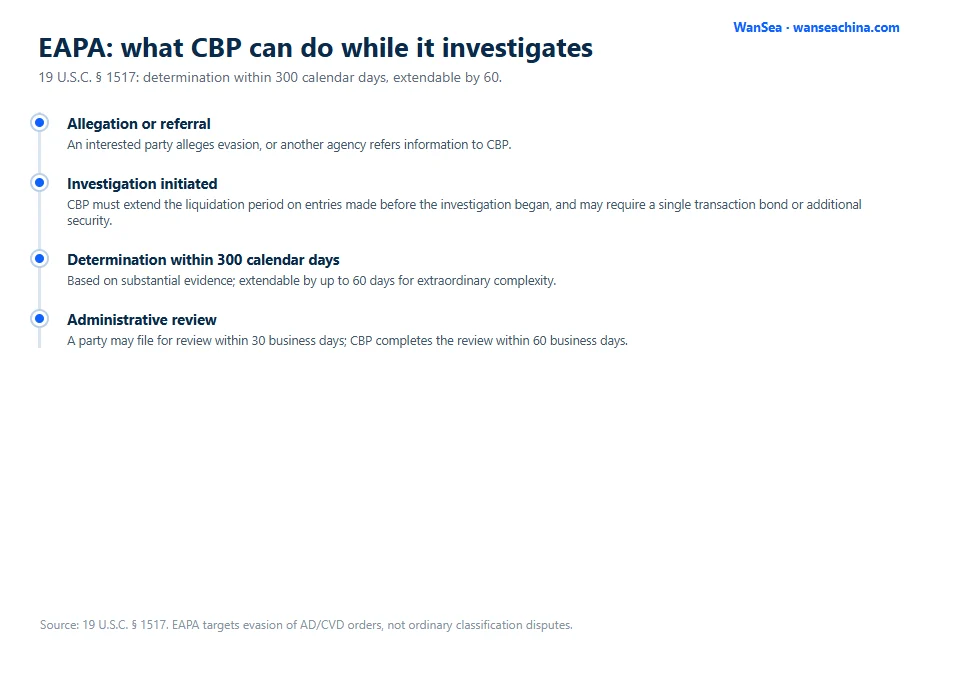
Sous le Enforce and Protect Act, an interested party can file an allegation that covered merchandise entered through evasion, or another agency can refer information to CBP. If the allegation reasonably suggests evasion, CBP initiates an investigation, and it makes a preliminary determination on reasonable suspicion within 90 calendar days of the initiation. Once that determination is affirmative, CBP must require a single transaction bond or additional security for covered entries. The statute gives the agency 300 calendar days to reach a determination based on substantial evidence, extendable by up to 60 days for extraordinary complexity.
The interim measures matter more than the final number. While the investigation runs, CBP must extend the liquidation period on unliquidated entries that entered before the investigation began, and, after the preliminary determination, it must require a single transaction bond or additional security. A party may file for administrative review within 30 business days of a determination, and CBP completes that review within 60 business days, but the goods and the cash flow are already affected long before then. CBP publishes its EAPA notices and dashboard, which is also where you can see how similar cases have been decided.
Why the order list is not the answer
Most importer searches stop at the order’s product list or the Chapter 99 tariff numbers attached to it. That is a reasonable first filter, not a conclusion. An AD/CVD order is built from a scope paragraph that describes merchandise, then adds a list of HTS subheadings that may contain it. The subheadings are illustrative of where the goods might be classified, not an exhaustive definition of what is covered.
Two consequences follow. A product can be covered even if its exact ten-digit code does not appear, because the scope describes the goods by their characteristics. And a product with a listed code can be outside the scope if its characteristics do not match, for example because it is a component rather than the finished article, or because it is explicitly excluded. Reading the scope paragraph line by line, including the exclusions, is the only way to reach a defensible answer.
Documenting origin, not just the invoice
Origin questions are where files usually fail. The invoice shows the country of export. The scope asks where the merchandise was produced, and customs will look for the production records that support the answer: bills of material, process sheets, sub-contractor invoices, and shipping documents that tie each input to the finished article. If a step happens in a third country, the file needs to show what that step was and why it changes the product.
A supplier letter that says “made in” a country is not production evidence. It is a statement, and it can be contradicted by the documents behind it. The practical test is whether a reviewer could reconstruct the manufacturing chain from your file without calling the factory. If not, the file is not ready for a scope question.
What an investigation costs before it ends
The financial exposure starts early. Suspended liquidation means the entries stay open, and the duty calculation is unresolved while the goods are already sold or in transit. A single transaction bond or additional security requires capital that was not in the landed cost. If the determination goes against the importer, the duty is assessed on the unliquidated entries covered by the determination, and the supplier indemnity becomes a separate collection problem in a different jurisdiction.
There is an operational cost as well. Importers under review often pause new orders from the same factory, which disrupts the supply plan, and the pause can outlast the investigation. Those costs rarely appear in the decision to accept a supplier’s assurance, which is why the scope file is worth building before the first shipment rather than after the first notice.
The short video below shows how a door-to-door shipment is put together, which is the part of the chain most exposed when an entry is suspended and the goods have to be held.
The scope question, in practice
Answering the scope question means describing the product the way the order describes it. Materials and composition come first, because many orders turn on the share of a metal, a fiber or a chemical. Dimensions and weight come next: thickness, diameter, capacity and unit weight are common scope boundaries. Then the manufacturing process, including where each step happened and whether any step was subcontracted. Finally, end use and packaging, because some scopes cover finished goods and explicitly exclude components, or the reverse.
Write the description once, in plain product terms, and keep it identical across the supplier questionnaire, the commercial invoice and the entry. Inconsistent descriptions are harder to defend than an incomplete one, because they suggest the file was assembled after the question was asked. If the facts genuinely sit near a boundary, that is the point to request a scope ruling from Commerce rather than guess.
When to ask for a scope ruling instead of guessing
A scope ruling is a public decision from Commerce on whether specific merchandise is covered by an order. It is the only answer that binds the agency on the question, and it is worth requesting when the product sits near a boundary, when the exposure is large, or when the same product will be imported repeatedly.
The request has to describe the merchandise the way the scope does, not the way the marketing brochure does. That means materials, dimensions, production process, end use, and a clear statement of the legal argument for inclusion or exclusion, with the scope language quoted. Vague requests produce vague answers, and a vague answer is not much better than the supplier’s promise. Requests take time, so the decision to file belongs at the sourcing stage, before the first production run rather than after the first entry.
Rulings are public, which has two effects. Competitors can read them, and customs can apply them consistently. Neither is a reason to avoid the process. A published ruling that excludes your product is a stronger protection than any private assurance, because it can be shown to a broker, an auditor or a new buyer without an explanation.
The file that answers the question
A defensible file has five parts. The product specification establishes the physical facts. The production records establish where the goods were made and by whom. A supplier questionnaire establishes the factory’s identity, capacity and whether it also produces covered goods, which is the question customs asks when it suspects a switch in sourcing. Prior rulings, whether from Commerce or CBP, establish how similar products have been treated. Entry history establishes what was declared before, including the HTS code, value and duty paid.
The file should exist before the order, not after the allegation. Assembling it later is possible, but every gap becomes a question, and the answers arrive under a deadline. Our guide to HS classification and who is responsible covers the classification side of the same file, and the entry-level mechanics sit in this aperçu du dédouanement.
Red flags worth taking seriously
Three patterns attract scrutiny. The first is a sudden change of origin: goods that used to ship from one country now ship from another, with no change in the product or the factory group. The second is minor processing presented as transformation: reassembly, repacking or a light finishing step in a third country, with the substantial production still in the covered country. The third is a value that does not reconcile with the inputs, especially when the invoice is split between related parties.
None of these is proof of evasion, and each can be legitimate. The problem is that each also looks like the fact pattern an allegation is built on. If your supply chain has one of them, document the reason before the entry is filed. A short explanation with supporting records is far easier to defend than a reconstruction after a suspension notice.
If an investigation opens
The first response is procedural: confirm what was suspended, what security is required, and what deadline applies to the response. The second is evidential: deliver the scope file in an organized form, with a short statement mapping each document to the scope element it supports. The third is commercial: tell the supplier what is needed and by when, in writing, because the clock does not pause while the factory looks for records.
Legal counsel is worth the cost at this point if the exposure is material. The administrative review window is short, and the arguments that succeed are usually about the scope language and the production facts, not about whether the importer acted in good faith.
The HTS Code Does Not Settle Scope; the File Does
A tariff classification is not a defense to an AD/CVD allegation. Before the next purchase order, confirm five things in writing: the exact scope language you believe applies and why, the production route with locations for each step, the factory’s identity and any related entities, the prior rulings on comparable products, and the entry history for the same goods. If any answer depends on the supplier’s word alone, treat the file as incomplete. The time to build it is while the goods are still being quoted, not while they are sitting under a suspension notice. If you want the scope file reviewed against the order before the order ships, send the product description and the production route, and we will map it to the scope language.